
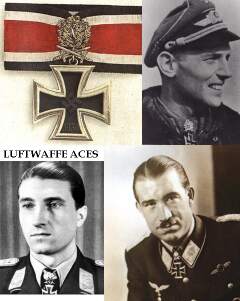
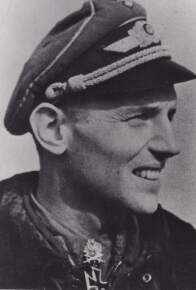
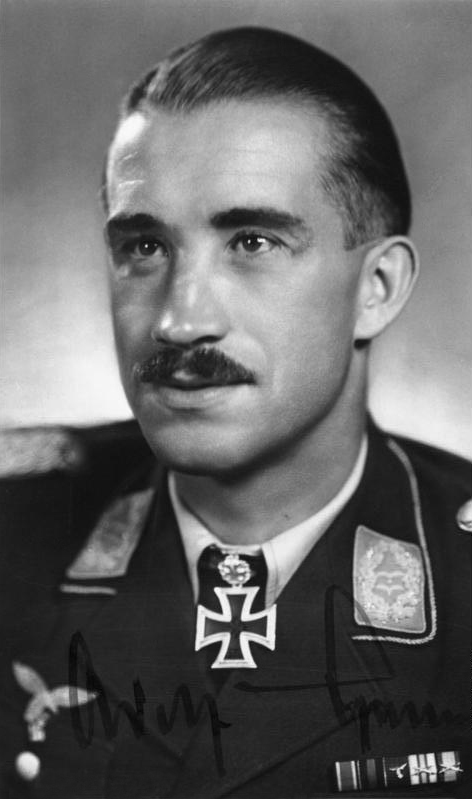
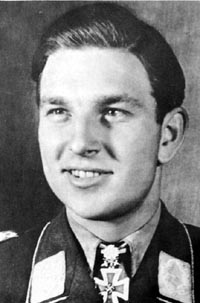
German Luftwaffe Aces
Messerschmitt Bf 109 and Focke Wulf 190 pilots
By Stephen Sherman, Aug. 2002. Updated July 7, 2011.
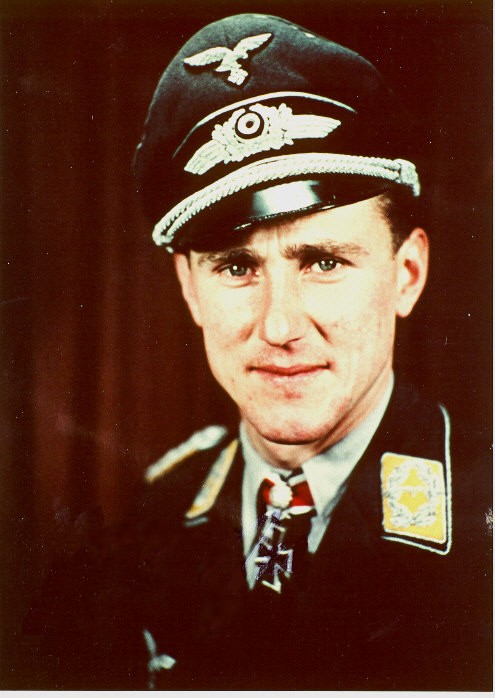
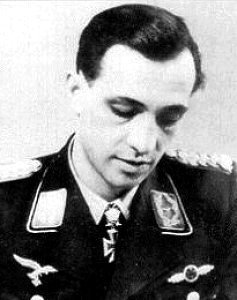
Several of them shot down more than 200 Allied airplanes. One of them, Erich Hartmann, destroyed 352 Russian planes. They flew, and racked up staggeringly high scores over North Africa, France, the Soviet Union, Great Britain, Poland, and, in the end, Germany itself. Two hundred aerial victories. By comparison, the top U.S. aces of World War Two achieved twenty or more; one of them, Major Richard Bong, shot down 40 Japanese planes. The leading aces of WWI, Manfred von Richthofen and Rene Fonck, 80 and 75. The high-scoring Russian and Japanese ace, about 60. The great U.S. aces of the Korean War knocked down fifteen MiGs.
While the 200+ kill Luftwaffe experten flew on the Eastern Front, many of their Western Front comrades scored over 100 kills.
How did they do this, when no other aces in history, from any nation, at any time, on any front, came close? As a group, were they ten times better fighter pilots than their American opponents, as the scores of 200 vs. 20 might imply? I don't think so. "Why did the German pilots of WW2 scored so high" is an interesting question. One reader asked, "Were they using different rules?" And that suggested a possible analogy, because, in fact, the Luftwaffe pilots were using the same rules as others, if anything, somewhat stricter rules. Historically, fighter pilots have scored a "kill" when their air force gives them official credit for the aerial destruction of any enemy aircraft. In most countries and services, the pilots own combat report, i.e. his own, unsupported word, his good faith, sufficed. Of course, novice pilots had to prove themselves, and first-timers who returned to base with claims of vast numbers of enemy fighters who fell beneath their guns were viewed skeptically. Luftwaffe pilots were required to have independent confirmation from another pilot. But basically they were "playing by the same rules."
The difference lay, not in the rules, nor in some nonsensical Aryan racial superiority, but rather in the conditions of combat. By analogy, consider home run hitters in baseball. For many years Babe Ruth's record of 714 home runs remained the top score. Eventually Henry Aaron passed that number. Other sluggers, from different teams and from different eras have hit 500, 600, or more home runs. Despite these differences, the achievements of the home run hitters remain essentially comparable. The conditions of their achievements remained essentially the same.
But suppose that some ballplayers played only 30 games a season rather than 162. Indeed when Roger Maris (playing in a 162-game season) broke Babe Ruth's single season home run record (set in a 154-game season), that difference merited baseball's most famous asterisk.
What if some hitters faced minor league pitchers while others faced major leaguers? What if ballparks varied greatly in size, some with 250-foot centerfields and others with 600-foot distances down the middle? What if some players played year-round? What if some hitters were assigned with getting singles and drawing walks?
What about differences in equipment? About 1920, baseball replaced the so-called "dead ball" with a livelier ball, and the game changed forever. No one would try to compare a Mickey Mantle to a "Home Run" Baker. Similarly, it would be difficult to compare the achievements of pilots who flew 200 hp biplanes to those who flew 1,200 hp WW2 monoplanes to those who flew jets in Korea.
The frequency of contests? On the Russian Front, most aerial combat occurred in the vicinity of the battle lines; it was all about tactical air support, not long range strategic bombing. The short distances permitted multiple missions per day, no 14-hour bomber escort missions, the Luftwaffe pilots frequently did two or three sorties in a day.
The length of the career? The Germans had a "fly till you die" policy. No rotation home for training duty. No limit on missions or combat hours. While such a short-sighted policy hampered the Luftwaffe's ability to turn out large numbers of well-trained pilots later in the war, it permitted those who excelled to rack up more and more missions and more and more aerial victories. One Luftwaffe experte, Erich Rudorffer, flew over 1,000 missions and was shot down himself sixteen times. American pilots generally finished a tour of duty and rotated home for training, command, or flight test assignments. Some immediately "re-upped" for more combat, but they were the exceptions.
The quality of the opposition? With no disrespect to brave Russian fliers nor to greatly skilled Russian aces like Pokryshkin (60 victories), the war on the Eastern Front (both on the ground and in the air) was one of quality vs. quantity. The Soviet Union had immense reserves of manpower, raw materials, and industrial goods (both from their own factories and from U.S. Lend-Lease equipment). And Stalin was not afraid to use his massive resources profligately. Many, many poorly trained Russian fliers went up in poorly made aircraft.
Varying assignments? By policy, many American fighter groups were assigned bomber escort duty. Their responsibility was to protect the bombers, not to zoom off, hunting down enemy planes to shoot down. The 332nd Fighter Group, the famed Tuskegee Airmen, is a case in point; the group's highest scoring pilot was credited with "only" 4 kills, but they rarely lost a bomber to enemy fighters.
Another matter, which perhaps doesn't have a direct analogy in baseball, is a "target-rich environment." In World War One, especially in the first two years of the war, airplanes did not exist in large numbers. There just weren't that many of them in the air. In World War Two, airplanes were mass-produced, with hundreds of thousands of combat aircraft delivered to the combatant nations. With the jet era, beginning in Korea, airplanes became much larger, much more complex, and much more expensive. An F-14 Tomcat or a MiG-29 cannot be compared to a WWII fighter plane. No nation will ever again field such a large number of airplanes. And, no fighter pilot will ever shoot such large numbers; the targets just don't exist. One can sense this in reading about the air war in Korea; a pervasive theme is "looking for the MiGs." Would the MiGs be flying on a given day? "Double aces," i.e. pilots with ten or more kills, were a rarity in Korea. In Vietnam, the U.S. had one or two aces. In the Gulf War, none; a few pilots downed two Iraqi aircraft.
It's reasonable to predict that we will never see another ace. The targets just don't exist in large enough numbers.
All the factors that created opportunities for aces to pile up huge scores came together for German Luftwaffe pilots on the Russian Front. Erich Hartmann scored 352; Gerhard Barkhorn 301; Günther Rall 275; Otto Kittel 267; and Walter Nowotny 258. The long-serving Erich Rudorffer downed 222 enemy aircraft on all fronts: 136 in the East, 48 in the West, 26 in North Africa, and then 12 more in Me.262 jets over Germany.
The top Luftwaffe aces of WW2, with over 170 aerial victories:
| Top German Aces | Kills | Comments | Medal | Unit | East | West | Plane |
| Erich Hartmann | 352 | First kill Nov. 1942 | KCOSD | JG 52 | 352 | - | Bf 109 |
| Gerhard Barkhorn | 301 | 120 sorties w/o a kill | KCOS | JG 52, 6, JV 44 | 301 | - | Bf 109 |
| Günther Rall | 275 | two long injury layoffs | KCOS | JG 52, 11, 300 | 272 | 3 | Bf 109 |
| Otto Kittel | 267 | 583 sorties, KIA Feb '45 | KCOS | JG 54 | 267 | - | Fw 190 |
| Walter Nowotny | 258 | Austrian, KIA Nov '44 | KCOSD | JG 54, Kdo. Nov. | 255 | 3 | Fw 190 |
| Wilhelm Batz | 237 | - | KCOS | JG 52 | 232 | 5 | Bf 109 |
| Erich Rudorffer | 222 | 1000+ sorties, downed 16 times, 12 Me 262 kills |
KCOS | JG 2, 54, 7 | 136 | 86 | Fw 190 |
| Heinz Bär | 220 | 16 in Me 262, downed 18 times | KCOS | various | 96 | 124 | various |
| Hermann Graf | 211 | 830+ sorties | KCOSD | various | 201 | 10 | Fw 190 |
| Heinrich Ehler | 209 | - | KCO | JG, 5, 7 | 209 | - | Bf 109 |
| Theodore Weissenburger | 208 | 500+ sorties, 8 kills with Me 262 |
KCO | JG 77, 5, 7 | 175 | 33 | Bf 109 |
| Hans Philipp | 206 | shot down by Robert S. Johnson | KCOS | JG 76, 54, 1 | 177 | 29 | Fw 190 |
| Walter Schuck | 206 | - | KCO | JG 5, 7 | 198 | 8 | Bf 109 |
| Anton Hafner | 204 | - | KCO | JG 51 | 184 | 20 | - |
| Helmut Lipfert | 203 | - | KCO | JG 52, 53 | 199 | 4 | Bf 109 |
| Walter Krupinksi | 197 | - | KCO | JG 52 | 177 | 20 | Bf 109 |
| Anton Hackl | 192 | - | KCOS | JG 77 | 130 | 62 | Bf 109 |
| Joachim Brendel | 189 | - | KCO | JG 51 | 189 | - | Fw 190 |
| Max Stotz | 189 | - | KCO | JG 54 | 173 | 16 | Fw 190 |
| Joachim Kirschner | 188 | - | KCO | JG 3 | 167 | 21 | Bf 109 |
| Kurt Brändle | 180 | - | KCO | JG 53, 3 | 160 | 20 | Bf 109 |
| Gunther Josten | 178 | - | KCO | JG 51 | 178 | - | - |
| Johannes "Macky" Steinhoff | 176 | - | KCOS | JG 52 | 148 | 28 | Bf 109 |
| Günther Schack | 174 | - | KCO | JG 51 | 174 | - | - |
| Heinz Schmidt | 173 | - | KCO | JG 52 | 173 | - | Bf 109 |
| Emil "Bully" Lang | 173 | 18 in one day | KCO | JG 54 | 148 | 25 | Fw 190 |
| Hans-Joachim Marseille | 158 | - | KCOSD | JG 27 | - | 158 | Bf 109 |
| Adolph Galland | 104 | - | KCOSD | JG.26, JG.27, JV.44 | - | 104 | Bf 109, Me 262 |
| Knights Cross (KC) with Oak Leaves (O), Swords (S), and Diamonds (D). More about WW2 German medals here. | |||||||
A fine book on this topic is 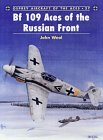 Bf
109 Aces of the Russian Front (Osprey Aircraft of the Aces
series #37) by John Weal.
Bf
109 Aces of the Russian Front (Osprey Aircraft of the Aces
series #37) by John Weal.
It covers Hartmann and his fellow Bf-109 pilots who flew on the Eastern Front; ten of whom shot down more than 200 aircraft.
Like all the Osprey Aircraft of the Aces series, includes detailed profile illustrations of the planes, as flown by individual pilots at certain times. Also lots of contemporary B&W photographs.
Sources:
- German
Jet Aces of World War 2 (Osprey Aircraft of the Aces No 17), by
Hugh Morgan, John Weal
- Bf
109 Aces of the Russian Front (Osprey Aircraft of the Aces series #37),
by John Weal.
- Focke-Wulf Fw 190 Aces of the Russian Front (Osprey Aircraft of the Aces, No 6), by John Weal
- Bf 109 Aces of North Africa and the Mediterranean (Osprey Aircraft of the Aces, No 2), by Jerry Scutts, Tony Holmes (Editor)
- Otto Kittel webpage - in both German and English, with many original photos of Kittel, some supplied by his family.
- Gerhard Barkhorn
webpage
- The Aces Talk (originally titled Fighter Tactics and Strategy, 1914-1970), by Edward Sims, Ballantine Books, 1972
- Rand McNally Encyclopedia of Military Aircraft: 1914-1980, by Enzio Angelucci, The Military Press, 1983