
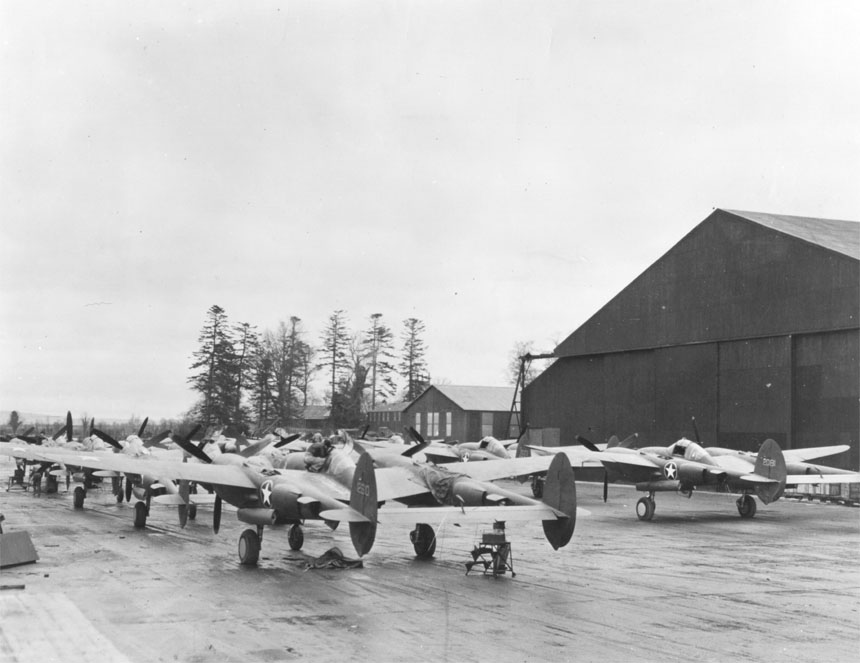
Lockheed P-38 Lightning
Twin-engine fighter used by Army fliers in the Pacific
9,200 planes produced, starting in March, 1942.
P-38J specs: 420 MPH, four 50 caliber machine guns, one 20 mm cannon
By Stephen Sherman, Apr. 2002. Updated January 24, 2012.
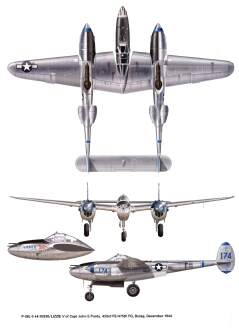
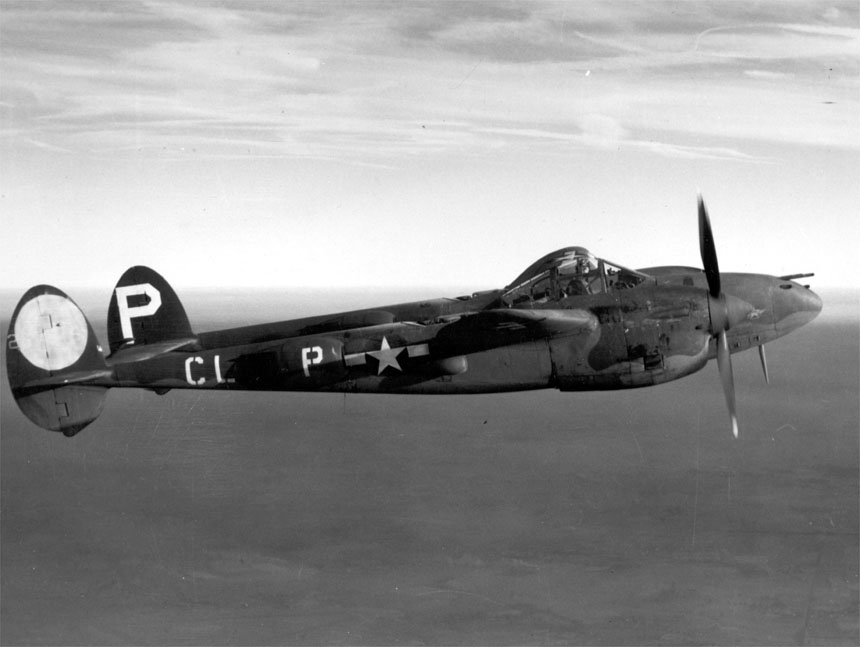
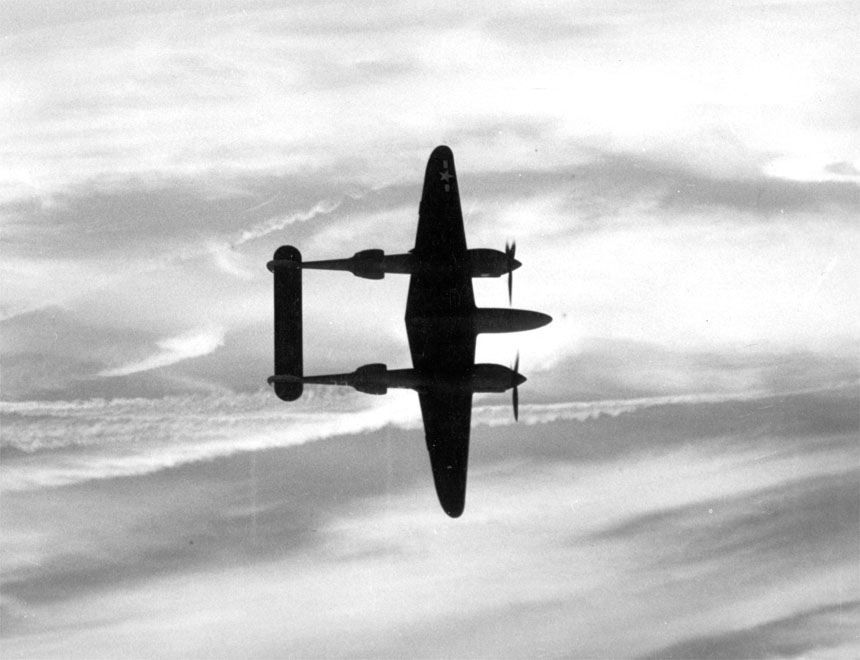
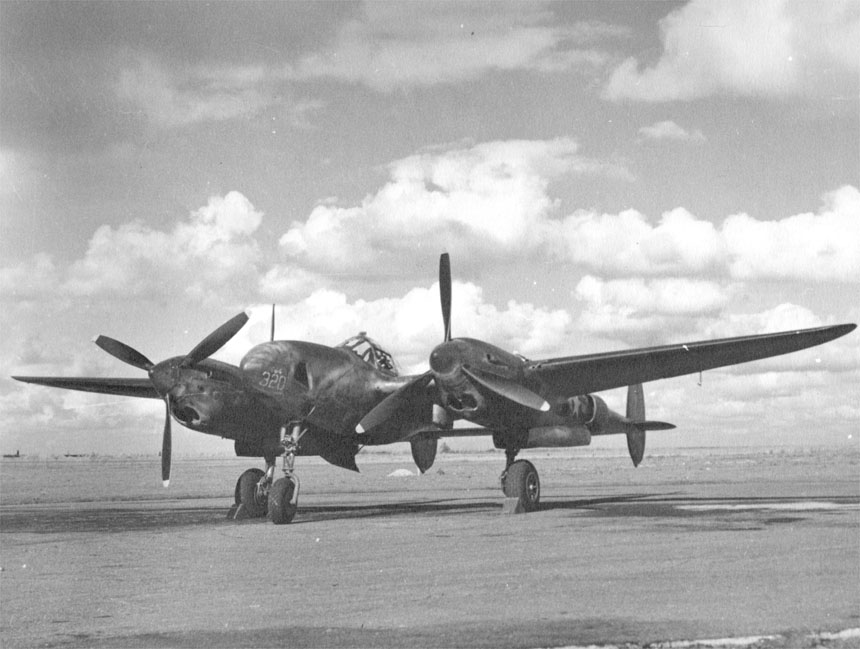
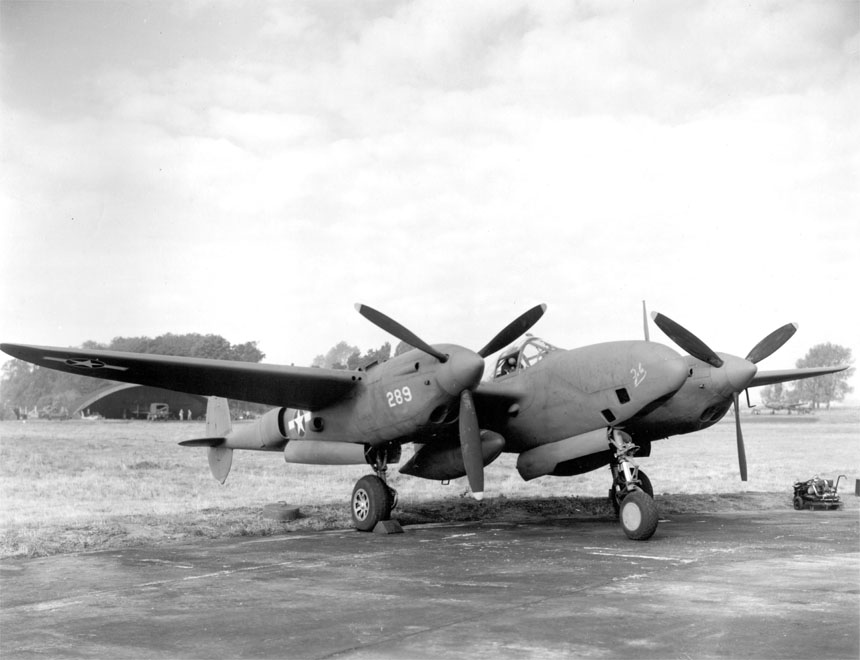
With its two engines mounted on twin booms and the pilot's separate nacelle in between, the P-38 looked like no other plane. Lockheed's brilliant designer Kelly Johnson created the plane in response to a 1937 Army specification for an interceptor that could reach 20,000 feet in 6 minutes. With the engines of the era, this was quite a challenge, and the innovative P-38 design resulted. After lengthy production delays, the Lockheed appeared in force in the Southwest Pacific in mid-1943, and proved a devastating fighter.
In Eric Bergerud's Fire in the Sky: The Air War in the South Pacific, Robert DeHaven, a 14-kill ace with the 49th Fighter Group, describes his reaction to the Lightning:
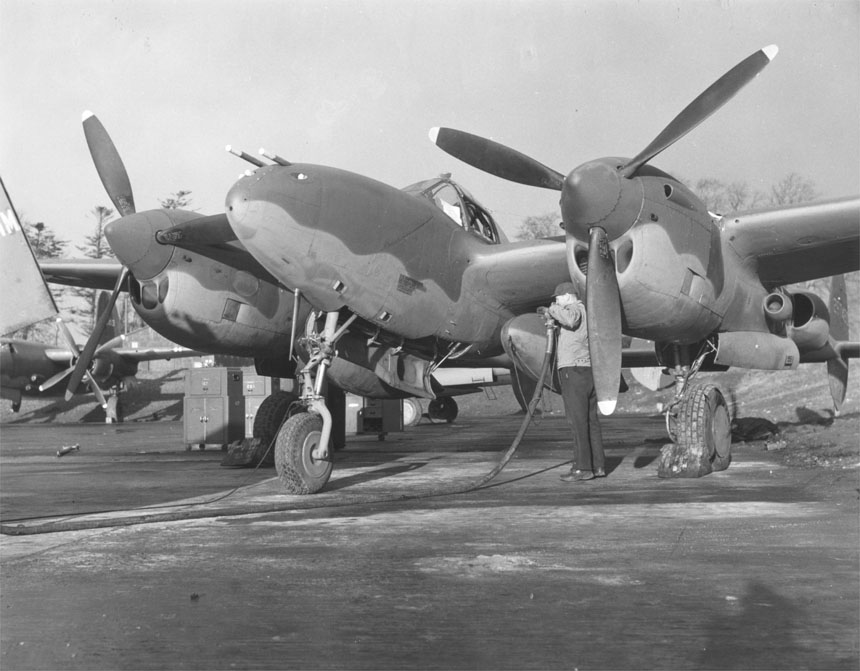
The P-38 was very unusual. Imagine what I felt when first climbing on board that airplane. Sitting on that tricycle landing gear, it was very high off the ground. There was a stepladder that dropped out of the tail end of the fuselage pod, and you took two steps up this ladder and the third step was onto the wing next to the canopy. ... It was a good sized airplane. In comparison the P-39 was a midget, almost like a toy.It was very fast and had good firepower. That gave a lot of people false confidence when they first went to P-38s. Their limitations on tactics were the same as those we were accustomed to in the P-40s, but even more so. You did not go looking for a close-in dogfight with an Oscar or Zero. Japanese planes were quicker ... at slow speed. But new pilots did not always realize the consequences. If the speed bled off a P-38, which happened very easily, it could be in serious trouble against a Japanese fighter. Many of our men found out the hard way, particularly when we first started receiving the P-38s.
Development and Early Models
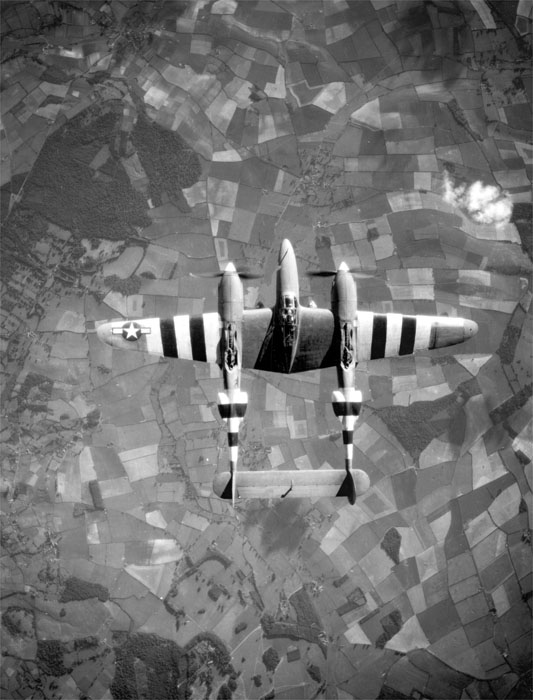
In 1937, the U.S. Army put out a requirement for a high-altitude interceptor capable of 360 MPH at 20,000 feet and full-throttle endurance of one hour at that altitude. Lockheed's design team, headed by H. L. Hibbard, include Clarence "Kelly" Johnson. With no contemporary engine that could meet the specifications, the Lockheed team settled on a twin engine design. The plane's radical configuration, twin booms with a central pilot/weapons nacelle and a horizontal tailplane stretching between the booms, offered many advantages:
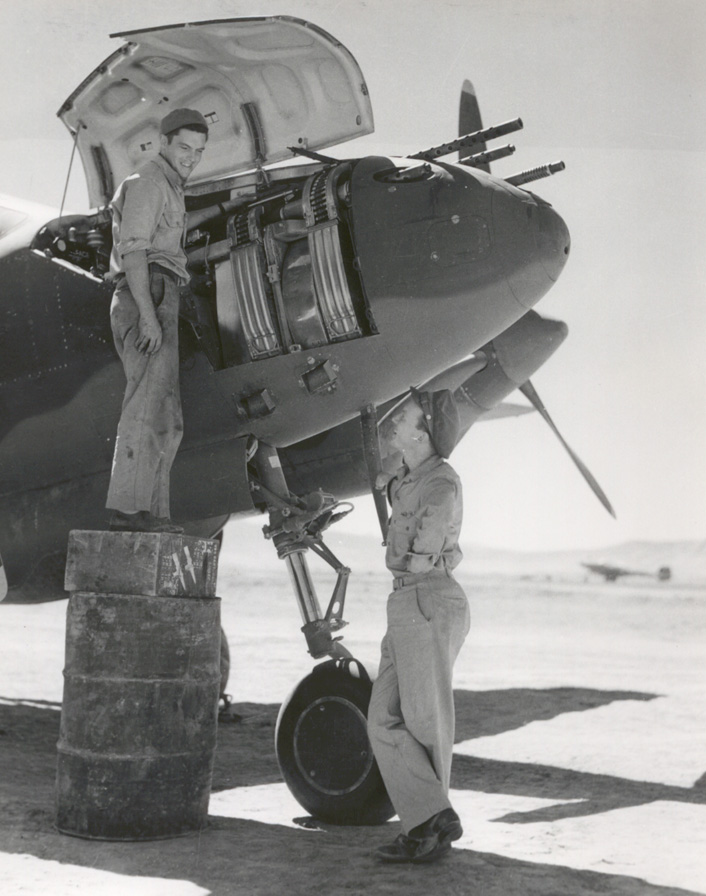
- The weapons (four .50 caliber machine guns and one cannon) need not be synchronized and could fire in a concentrated parallel stream.
- Superchargers and radiators had plenty of room in the booms, aft of the engines.
- The main landing gear could also tuck up into the booms.
- With a nose wheel completing a tricycle landing gear, the pilot could see where he was going while taxiing and taking off.
The Army awarded a contract to Lockheed in July, 1937 for one prototype, the XP-38. Powered by two 1000-HP Allison V-1710-11/15 engines, driving counter-rotating propellers, the unarmed, stripped-down XP-38 first flew in January, 1939, with Air Corps Project Officer Ben Kelsey at the controls. The XP-38 achieved 414 MPH and was a great success. The next step was an attempted record-breaking cross country flight. Unfortunately the aircraft lost power and crashed at Mitchell Field, Long Island; it was a total loss.
YP-38
Despite the destruction of the prototype, the Army ordered 13 YP-38 pre-production test airplanes. These differed from the XP-38 in armament, in larger radiators, and in more powerful (1150-HP) Allison V-1710-27/29 engines. The first YP-38 flew in September, 1940, and delivery to the Army took place in Spring, 1941. The weapons package was changed to include a 37 mm cannon (instead of a 20 mm), as well as two .30 caliber and two .50 calibers (instead of four .50 calibers).
P-38
The next version, designated simply P-38, reinstated the original armament of four .50 caliber machine guns and one 20 mm cannon. It also added bulletproof glass and armor plate. The -A, -B, and -C suffixes were only used for preliminary and experimental versions.
P-38D
The experience of aerial combat in Europe led to further refinements on the next production version, the P-38D: a low-pressure oxygen system, self-sealing fuel tanks, and some aerodynamic changes to resolve tail buffeting in dives.
P-38D aircraft reached USAAF squadrons in August, 1941, but the military did not consider them ready for combat; as such they were re-designated RP-38D,"R" for "Restricted to non-combat roles," amd only used for training. By December, 1941, 69 of these early P-38's were on active duty. In 1940, the British and French had ordered several hundred P-38's. Between the fall of France and British dissatisfaction with the Lightnings' performance, very few were delivered. Most of these airframes (ordered by the European allies) were kept by Lockheed as training/experimental models or were eventually completed as models P-38F or P-38G.
P-38E
Despite being "in production," the early model Lightnings continued to have teething problems. Lockheed delivered 210 of the P-38E. In this version, the nose-mounted weapons package that prevailed through the rest of the Lightning's design history was installed: four .50 caliber machine guns and one 20mm cannon. Improvements in the -E included a larger ammunition capacity, an SCR-274N radio, Curtiss Electric propellers, and an Allison V-1710-27/29 engine.
Some early P-38's were lost when pilots could not pullout from high-speed dives. The buffeting, tail-flutter, and compressibility that these P-38's encountered as they approached trans-sonic speeds (Mach 0.67 to 0.72) did not result from any design flaw of the aircraft. The P-38 happened to be one of the first to achieve these speeds and thus the first to experience these symptoms. More aerodynamic changes in the P-38E helped, but did not fully resolve, these challenges.
Most P-38E's were restricted to training, as RP-38E's.
First Combat Models: P-38F and P-38G
The P-38F, the first version to see combat, carried the same armament as the -E. Lockheed built 527 of them. Among other features, it employed the widely-used SCR-522 radio. (It used four channels in the VHF band, between 100 and 156Mhz; it weighed 91 pounds and was 17 inches wide, about a foot high, and a foot deep. SCR initially meant "Set, Complete Radio," and later "Signal Corps Radio.")Starting with production block P-38F-1-LO, Lockheed provided for drop tanks, increasing range to 2200 miles. These tanks enabled P-38F's of the 1st and 14th Fighter Groups to fly to Britain in August, 1942, stopping in Maine, Labrador, Greenland, and Iceland. Two squadrons stayed in Iceland, to patrol over the Atlantic. While on such a patrol, on August 14, 1942, 2nd Lt. Elza Shahan, flying a P-38F, shared in the destruction of a Focke-Wulf Fw 200 Condor, the first USAAF shoot-down of a Luftwaffe plane.
The 82nd Fighter Group, another P-38F group, joined the 1st and 14th in Europe in November, 1942. Shortly all three groups were transferred to North Africa, the MTO. En route, over the Bay of Biscay, 82nd FG pilots downed two Ju 88 bombers. Several P-38's of the 1st FG, low on fuel, were forced down in Portugal, likely candidates for internment. In a comical scene, recounted in Aces in Combat: The American Aces Speak, Vol 5, by Eric Hammel, Lt. Jack Ilfrey made good his escape, while demonstrating the airplane's features to his armed Portuguese "hosts."
In North Africa, the P-38 groups began to face off against the Germans. By the end of November, Lieutenants Virgil Lusk, Ervin Ethell, and James Butler shot down four Axis planes each: Savoia-Marchetti SM-81 Pipistrello and Junkers Ju 52 transports. Despite the superior capabilites of the Bf 109, two other MTO P-38F pilots "made ace" before 1942 was out: Lts. Virgil Smith and Jack Ilfrey.
With demands from all theatres and with Lockheed's production rate still growing, not many squadrons could be equipped with Lightnings. In the Pacific, the Fifth Air Force units (responsible for Australia & New Guinea) that received early P-38's included:
- The 39th FS, of the 35th FG, received P-38's in late summer 1942.
- The 9th FS, of the 49th FG, in January, 1943.
- The 80th FS, of the 8th FG, also in January, 1943.
- It wasn't until mid-1944 that the 475th FG, an all-Lightning outfit, was activated.
On December 27, 1942, the Lightnings proved their mettle over Dobodura, the advanced Allied base on New Guinea. About 60 Japanese Vals, Zeros, and Oscars struck Dobodura in the late morning. Alerted by coastwatchers, the 39th FS Lightnings (a mix of p-38F's and P-38G's), led by Tom Lynch and Dick Bong, intercepted. The powerful armament of the Lynch's P-38 chopped one of the Oscars in half, and the American pilots claimed eleven kills overall, while suffering only one write-off (Ken Sparks' machine was badly damaged and crash-landed.) While Japanese sources only record three losses, it was clear that the Lightnings could outgun the light Japanese planes.
On the 1st of March, Allied intelligence picked up vital
information. The Japanese planned to reinforce their garrison at Lae
with 7,000 soldiers. Their force consisted of eight Maru (7
troop ships and 1 cargo ship laden with aviation fuel) and eight
destroyers, with 30 Zeros on CAP. General Kenney ordered an all-out
attack, 200 bombers and 130 fighters, which was very successful.
Covered by P-38's, P-39's, and P-40's, the American bombers ripped into
the thin-skinned Japanese vessels, sinking all eight Maru and
four destroyers. (Read a more detailed account of the Battle of the
Bismarck Sea here.) The aerial destruction of 15-20 Zeroes was
icing on the cake. Lynch shot one down. The aggressive Bob Faurot and
Hoyt Eason, flying in Faurot's division, were killed that day.
The P-38G began to roll out in June, 1942.
Lockheed accelerated its production, turning out 120 per month,
completing 1082 P-38G's by March, 1943. This version was
essentially similar to late-block P-38F's.
(Aircraft manufacturers defined "production blocks," within the
series, e.g. production block P-38G-5-LO, but that level of
detail is beyond this article, where as needed, reference will be made
to "late-block" or "early block.")
381 were completed as photographic reconnaissance versions F-5A
and F-5B. In early 1943, P-38G's began to appear in the
Mediterranean and Pacific Theatres.
The P-38H was like the late-block P-38G; 601 built.
Yamamoto Raid
In late 1942, the Thirteenth Air Force, based on Guadalcanal, had also received some Lightnings for its 339th Squadron of the 347th FG. A couple of these were equipped with radar, in an effort to deal with "Washing Machine Charlie," Japanese nocturnal raiders over Guadalcanal.
On April 18, 1943, Lightnings of the 339th carried out the most famous fighter mission of the war, the assassination of Admiral Yamamoto. Intelligence found out that Yamamoto would be inspecting the Japanese base at Bougainville, and with approval from "the highest levels," a mission was ordered to get him. Only P-38's, with special, large drop tanks would have the range. The USAAF officers planned the intercept to the minute. Early in the morning, eighteen Lightnings took off, following a circuitous course at wavetop level ... Read a more detailed account of the Yamamoto Mission.
P-38J
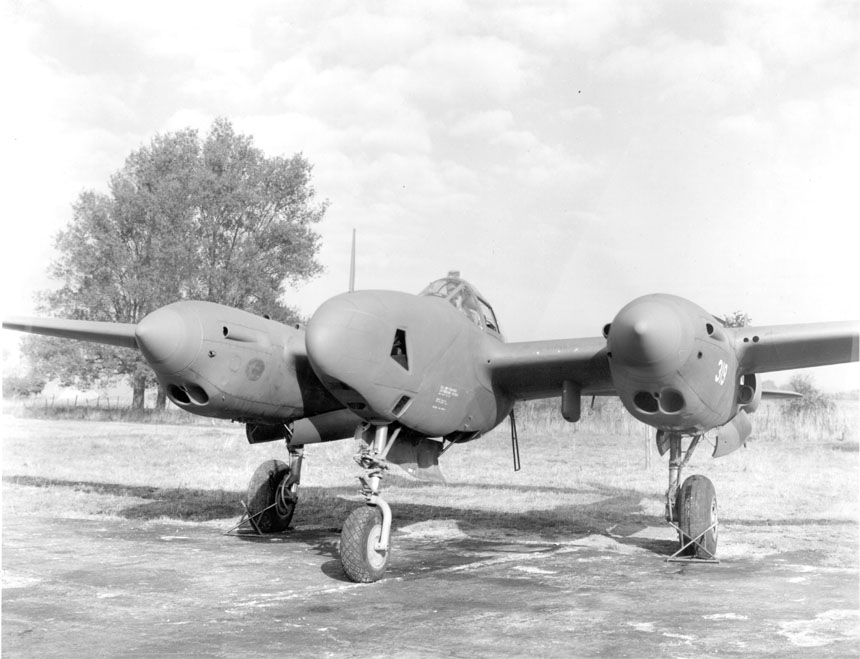
Visibly different, with deep "chin" radiators, changing the profile of the engine nacelles.
Early P-38's had cooled the compressed, and therefore very hot, air coming fomr the turbosuperchargers by ducting it through the leading edge of the wing. This had proven to be an unsatisfactory arrangement. The P-38J substituted an intercooler below the engine, which drew its air from large intakes in a lower, deeper nose. While this design increased drag somewhat, the cooler air enabled the V-1710-89/91 engines to operate more efficiently at high altitudes. Because of this change, the P-38J was the fastest Lightning, capable of 420 MPH at 26,000 feet, about 20 MPH faster than the -G and -H versions.
In a related benefit, Lockheed put fuel tanks in the newly available space in the wing leading edges. With drop tanks, the P-38J had a range of 2260 miles, enabled by its 1010 gallon fuel capacity:
- 110 gallons, in two 55 gal. leading edge tanks
- 180 gallons, in two 90 gal. main fuel tanks, located in the wings between the engine nacelles and the center
- 120 gallons, in two 60 gal. reserve tanks, also between the engine nacelles
- 500 gallons, in two 250 gal. drop tanks
The P-38J finally resolved the compressibility problems encountered in high-speed dives, when a shock wave forming over the wings made it impossible for a pilot to operate the elevators. Once this was understood to be the problem, Lockheed engineers designed small dive flaps, electrically-powered, that broke up the shock wave. These corrective dive flaps were installed on all P-38's, starting with late-block -J versions.
Over the Mediterranean
The Lightnings of the 1st, 14th, and 82nd Fighter Groups supported the Allied drive eastward across North Africa and then into Italy. The top P-38 ace of the MTO, William "Dixie" Sloan, arrived in Algeria, with the 82nd, at the end of 1942. During his B-26 escort and other missions, he shot down 12 German planes.
Another celebrated P-38 ace of the Mediterranean, was Bill Leverette, who on October 9, 1943, led the destruction of a flight of Ju 87 Stukas over the Aegean Sea. On that day, the USAAF pilots claimed 16 Stukas destroyed, 7 by Leverette himslef, for which he earned a DSC. Read Leverette's story here.
Over Europe
For a variety of reasons, the P-38 was not highly regarded, nor widely used, in the European Theater.
Later Lightnings
The last production version was the P-38L, and the most numerous, almost 4,000 being built. The -L model included the latest Allison engine, the V-1710-111/113; otherwise, it resembled the late-block P-38J. Photographic versions of the P-38L were designated F-5F and F-5G.
Bong and McGuire
These two aces scored 40 and 38 aerial victories, respectively, while flying P-38's against the Japanese. Personally, they were very different: Bong was a mild-mannered, self-effacing farm boy, popular with his squadron mates and the press. McGuire was brash, more openly ambitious, less well-liked by his peers, as even his laudatory biographer, Charles A. Martin, admits in The Last Great Ace: The Life of Major Thomas B. McGuire, Jr. . McGuire flew with the 475th Fighter group, and rose to command its 433rd Squadron. Bong started with the 35th group, but shortly moved up to a special status, a "free-lance ace," reporting to Fifth Fighter Command HQ, roving around, looking for Japanese targets.
Neither of them (the two highest scoring aces in American history) survived the war. McGuire was shot down in combat in January, 1945, while Bong died test-flying the P-80, in August 6, 1945.
Read the Richard I. Bong article on this site.
Find out about Thomas McGuire.
Top P-38 Lightning aces
Follow the links to read their stories.
| Name | Kills | Medals | Theatre/AF | Unit | Plane |
|---|---|---|---|---|---|
| Richard I. Bong | 40.0 | MH | PTO/5AF | 49FG | Marge |
| Thomas McGuire | 38.0 | MH | PTO/5AF | 475FG | Pudgy V |
| Charles MacDonald | 27.0 | DSC | PTO/5AF | 475FG | Putt Putt Maru |
| Gerald R. Johnson | 22.0 | DSC | PTO/5AF | 49FG | Barbara |
| Jay T. Robbins | 22.0 | DSC | PTO/5AF | 8FG | Jandina |
| Robert Westbrook | 20.0 | - | PTO/13AF | 18FG | P-38 |
| Thomas J. Lynch | 20.0 | DSC | PTO/5AF | 35FG | P-38 |
| Bill Harris | 16.0 | - | PTO/13AF | 18FG | P-38 |
| George S. Welch | 16.0 | DSC | PTO/5AF | 8FG | - |
| Edward "Porky" Cragg | 15.0 | - | PTO/5AF | 8FG | Porky II |
| Cyril F. Homer | 15.0 | - | PTO/5AF | 8FG | Uncle Cy's Angel |
| Daniel T. Roberts Jr. | 14.0 | DSC | PTO/5AF | 475FG | P-38 |
| Cotesworth B. Head Jr. | 12.0 | - | PTO/13AF | 18FG | P-38 |
| Kenneth G. Ladd | 12.0 | - | PTO/5AF | 8FG | Windy City Ruthie |
| James A. Watkins | 12.0 | - | PTO/5AF | 49FG | P-38 |
| Richard L. West | 12.0 | - | PTO/5AF | 8FG | - |
| Francis J. Lent | 11.0 | SS | PTO/5AF | 475FG | T.Rigor Mortis |
| John S. Loisel | 11.0 | SS | PTO/5AF | 475FG | Screamin' Kid |
| John W. Mitchell | 11.0 | - | PTO/13AF | 18FG | P-38 |
| Murray "Jim" Shubin | 11.0 | DSC | PTO/13AF | 347FG | Oriole |
| Cornelius Smith | 11.0 | - | PTO/5AF | 8FG | Corky III |
| Ken Sparks | 11.0 | 35FG | PTO/5AF | - | - |
| William Giroux | 10.0 | - | PTO/5AF | 8FG | Whilma II/ Dead Eye Daisy |
| Paul Stanch | 10.0 | - | PTO/5AF | - | Regina I |
| Elliot Summer | 10.0 | - | PTO/5AF | - | - |
| Fredric Champlin | 9.0 | - | PTO/5AF | - | Eileen-Anne |
| Tom Lanphier | 4.5 | NC | PTO/13AF | 347FG | P-38 |
| Rex Barber | 5.0 | NC | PTO/13AF | 347FG | P-38 |
Specifications of P-38 production variants:
| P-38 | Production | Speed | Armament | Engine and Performance | Weight | Other | ||||||||||||
|---|---|---|---|---|---|---|---|---|---|---|---|---|---|---|---|---|---|---|
| Variant | Svc. Del. | # Built | MPH | 8mm | 12.7/13mm | 20mm | 37mm+ | Bomb | HP | Engine(Mfr/Number) | Climb ft/min | Ceil FT | Rng Mi. | Ext Rng | Empty Wt. lb. | Loaded Wt. | Max.Wt. lb. | Modif. |
| P-38F | Mar-42 | 638 | 395 | 4 | 1 | 1,325 | Allison V-1710-49/53 | 2,850 | 39,044 | 850 | 12,264 | 15,900 | 18,000 | |||||
| P-38G | Jul-42 | 1,082 | 400 | 4 | 1 | 2,000 | 1,325 | Allison V-1710-51/55 | 2,850 | 39,000 | 850 | 1,750 | 12,200 | 15,800 | 19,800 | |||
| P-38H | Apr-43 | 601 | 400 | 4 | 1 | 3,200 | 1,425 | Allison V-1710-89/91 | 2,850 | 40,000 | 850 | 2,400 | 12,380 | 16,000 | 20,300 | eng.+ | ||
| P-38J | Sep-43 | 2,970 | 420 | 4 | 1 | 3,200 | 1,425 | Allison V-1710-89/91 | 2,850 | 44,000 | 1,175 | 2,260 | 12,780 | 17,500 | 21,600 | deeper nose | ||
| P-38L | Jun-44 | 3,923 | 414 | 4 | 1 | 3,200 | 1,475 | Allison V-1710-111/113 | 2,850 | 40,000 | 1,175 | 2,260 | 14,112 | 17,500 | 21,618 | |||