

P-51 Mustang - Page 2
Service in the ETO, Table of Aces, and Post-War
By Stephen Sherman, Apr. 2002. Updated January 26, 2012.
Dec. '43 - 354th FG Takes Mustang into Combat in ETO
The 354th Fighter Group, dubbed "Pioneers," started flying P-51B's over France in December, 1943. Originally part of the Ninth Air Force, the 354th was loaned to the Eighth for bomber escort duty. They received their Merlin-powered P-51B's in November, along with the formidable Don Blakeslee as a temporary CO.
Blakeslee led the 354th on several missions and drove the pilots hard; he insisted that they engage the German fighters and maintain a collision course, in a deadly game of aerial "chicken," counting on the Germans to break off first. The 354th flew through the bad winter weather of 1943-44, typically dividing its three squadrons into four color-coded flights of four planes each.
Among the outstanding pilots of the 354th that winter were Glenn Eagleston and Jim Howard. Howard earned the Medal of Honor for shooting down six Bf 110's on January 12, 1944. (Officially, he only claimed two destroyed and four probables.) Unfamiliar with bomber escorts like the Mustangs, the Luftwaffe employed twin-engine Bf 110 Zerstorer types against the USAAF, with little success. The 354th resumed its original tactical role in Spring 1944, in preparation for D-Day. In mid- June, they moved to Criqueville, an advanced base in Normandy and simultaneously returned to the Ninth Air Force command. Supporting the Allied ground advance and following it from forward bases, the 354th moved again, to Gael in August, then to Orconte in September. Lt. Col. Lowell Brueland and Major Richard Turner distinguished themselves in this period.
In the 1944-45 winter, the 354th flew P-47's before equipping again with P-51's in early 1945.
Apr. '44 - MTO Groups Get Mustangs
By early 1944, the delivery of P51-B/C models began to accelerate. Among the early beneficiaries were the 31st and 52nd Fighter Groups of the Fifteenth Air Force (15AF). Formerly flying Spitfires, as part of the Twelfth Air Force, the 31st and 52nd transitioned to Mustangs in April, at the same time as they were transferred to the 15AF. On April 21, the 31st flew their new mounts, P-51B's, to escort B-24's on a bombing mission over Ploesti, Romania. They claimed 17 German planes destroyed, with losses of two Mustangs; for this mission they received a Distinguished Unit Citation.
Operating from rough-and-ready bases in Italy, places like Ghisonaccia, Madna, San Severo, Ramitelli, and Lesina, the 15AF fighter pilots primarily flew escort missions to targets in Romania, Austria, Czechoslovakia, and southern Germany. Two other 15AF fighter groups, the 325th "Checkertails," and the famed 332nd Tuskegee Airmen "Redtails," also received the Mustangs in Spring 1944. All four of these groups transitioned to the -D model within a few months.Some notable Mustang aces of the MTO whose stories are told here include: Robert Goebel, Herky Green, John Voll, and James Varnell.
June '44 - Arrival of -D Models
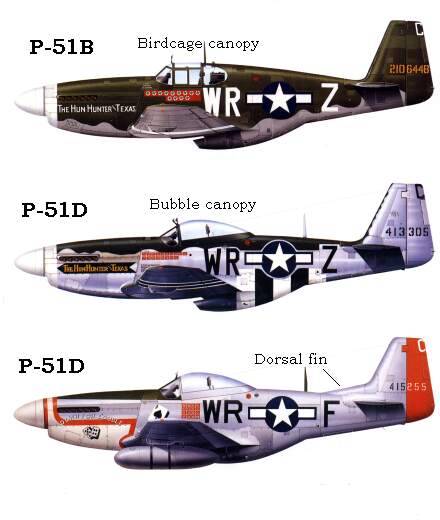
By far the most numerous P-51 (over 8,000 produced) and also the best known, the -D model development began in 1943. It improved two drawbacks of the B/C model: poor rearward visibility and inadequate firepower of four machine guns (which were mounted at an angle and were subject to frequent jams).
Even the Malcolm hood hadn't fixed the P-51's rearward visibility problem. Learning from the British installation of a "bubble" or "tear-drop" canopy in the Spitfire, both Republic (for its P-47) and North American Aviation (for the P-51) started work on a Plexiglass bubble canopy in mid-1943. For stability, and to prevent distortion, the canopy was mounted in a very deep, rubber-lined metal sill; it slid back on rails. To accommodate the canopy, the rear fuselage was cut down. The new version included six .50 caliber machine guns, mounted upright, minimizing jams.
Test pilot Bob Chilton first flew the XP51-D in November, 1943. The Inglewood plant eventually turned out 6500 -D models; the Dallas plant produced 1600 of the identical -K model.
The 85 gallon fuselage tank was included on the P51-D from the start. The directional stability problems that it caused for the B/C models worsened in the first D models. To correct this, a dorsal fin was added, starting with the Block 10 of the P-51D.
Another new feature of the P-51D was the K-14 gunsight, which greatly assisted deflection shooting. The K-14 computed and displayed the correct angle of deflection needed to hit a moving airplane. The pilot entered the wingspan of the target and the range, lined up the target in the pipper, and pressed the trigger button.
June '44 - Mustangs in the ETO, Mission to Russia
It was in the European Theatre, flying over Germany, that made the Mustang and many of its pilots famous. The Eighth Air Force had struggled with its daylight bombing missions over Germany; unescorted, the bomber losses were unsustainable. With the Merlin engine, the Mustang could fly over eight hours, and have time to dogfight the Luftwaffe as well. As mentioned above, the 354th Fighter Group, temporarily assigned to the Eighth AF, was the first group to fly Mustangs over Europe. Other groups followed. The 357th flew its first Mustang combat missions in February, 1944. Shortly, the 4th Fighter Group, whose boss, Don Blakeslee, had been tirelessly begging for Mustangs, received their P-51B's, in time for "Big Week," the USAAF late-February assault on Germany. "Big Week" was a direct attack on Germany's fighter force: bombing its manufacturing plants and airfields, and shooting its operational planes out of the sky.
In early 1944, VIII Fighter Command (VIII FC) focused on destroying the Luftwaffe. It encouraged and publicized aces; destruction of planes on the ground "counted" in a pilot's tally. This was an unusual step; no other air force has ever recognized "ground kills" in a fighter pilots claims. But VIII FC figured that "a plane was a plane" and strafing was hazardous and unpopular. So it offered the recognition.
They also juggled the sometimes conflicting demands of morale and manpower requirements. Early on, the 8th followed RAF policy, rotating pilots off front-line combat after 200 hours. But the extended escort missions used up 200 hours quickly; eventually the limit was raised to 300 hours. Indeed the USAAF recognized the value of sending experienced pilots home to train new ones. The Germans tended to keep their pilots at the front, until they were killed or until the war ended. Consequently, later Mustang pilots frequently found their German opponents to be untrained.
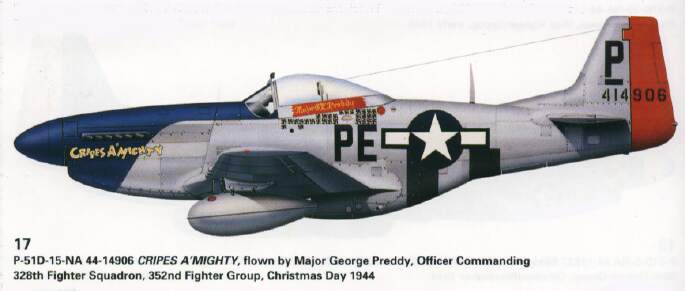
Decoration of personal aircraft with kill-markers, little swastikas or crosses near the canopy rail, was permitted or even encouraged. As was decoration of planes with group color schemes, thus the 352nd were the "Blue-Nosed Bastards of Bodney."
Highest scoring P-51 aces of the ETO
| Name | Kills | Medals | Unit | Plane |
|---|---|---|---|---|
| George Preddy | 26.8 | DSC | 352FG | Cripes A' Mighty |
| John C. Meyer | 24.0 | DSC | 352FG | Petie 3rd |
| Ray Wetmore | 22.6 | - | 359FG | Daddy's Girl |
| Dominic Gentile | 21.8 | DSC | 4FG | Shangri-La |
| Leonard 'Kit' Carson | 18.5 | - | 357FG | Nooky Booky IV |
| Glenn T. Eagleston | 18.5 | - | 354FG | - |
| John Godfrey | 18.0 | DFC | 4FG | Reggie's Reply |
| John B. England | 17.5 | DFC | 357FG | U've Had It |
| John F. Thornell Jr. | 17.3 | DSC | 352FG | Patty Ann II |
| Henry W. Brown | 17.2 | DFC | 355FG | Hun Hunter from Texas |
| Robert W. Foy | 17.0 | - | 357FG |
Reluctant Rebel / Little Shrimp |
| Ralph 'Kid' Hofer | 16.5 | DFC | 4FG | Salem Representative |
| Clarence 'Bud' Anderson | 16.3 | - | 357FG | Old Crow |
| Don Blakeslee | 15.5 | DFC | 4FG | WD-C |
| Richard A. Peterson | 15.5 | - | 357FG | Hurry Home Honey |
| William Whisner | 15.5 | DSC | 352FG | Moonbeam McSwine |
| Donald Bochkay | 14.8 | - | 357FG | Speedball Alice |
| Donald Strait | 13.5 | - | 356FG | Jersey Jerk |
| Donald S. Bryan | 13.3 | - | 352FG | Little One III |
| Glennon T. Moran | 13.0 | - | 352FG | Little Ann |
| Clyde B. East | 12.0 | - | 10PRG | Lil Margaret |
| George W. Gleason | 12.0 | - | 479FG | Hot Toddy |
| Howard Hively | 12.0 | - | 4FG | The Deacon |
| Pierce W. McKennon | 12.0 | - | 4FG | Ridge Runner |
| Robin Olds | 12.0 | - | 479FG | Scat VII |
| Nick Megura | 11.8 | - | 4FG | Ill Wind |
| Chuck Yeager | 11.5 | DSC | 357FG | Glamorous Glen |
| Louis Norley | 11.3 | - | 4FG | Red Dog XII |
| Urban Drew | 6.0 | - | 361FG | Detroit Miss |
Other Mustang nicknames included:
Betty-E, Betty Jo IV, Betty Lee III, Big Beautiful Doll, Boise Bee,
Boomerang Jr,
Constance, Dana Kay, Dove of Peace, Down for Double,
Ferocious Frankie, Happy Jack's Go Buggy, HELL-ER-BUST, June, Katydid,
Little Chic, Lousiana Heat Wave, Lucky Lady VII, Luscious Jr,
Man O' War, Milly, Miss Marilyn II, Missouri Armada, Missouri Mauler,
Miss Steve,
Nite, OLE II, Penny 4, Princess Elizabeth, Slender Tender & Tall,
Texas Terror IV, The Impatient Virgin, The Iowa Beaut, The Only
Genevieve, The Shillelagh, The Yakima Chief, Thunder Bird, Yi-Yi,
© Osprey Publishing Ltd, www.ospreypublishing.com
Oct. '44 - Ben Drew Downs Two Jets
The German Me 262 jets could outfly the Mustangs by 100 MPH in level flight. Fighting them on equal terms, at altitude, was hopeless. Their only weakness was their slow acceleration, so they were vulnerable at take-off. The Mustang pilots sought to make the most of this (and of their superior numbers) by loitering over Me 262 airfields. On October 7, 1944, he was over the Achmer airfield and surprised two jets taking off, and shot them both down. (I am not positive, but I think this was the only double victory ever recorded by a piston-engined aircraft over jet-powered enemies. - SS.)
Jan. '45 - Operation Bodenplatte
On New Year's Day, 1945, the Luftwaffe made a final mighty assault, in an all-out effort. The 352nd Group, of which John C. Meyer was then deputy commander, was operating from field Y-29, Asche, Belgium. Meyer had a hunch that the Luftwaffe might gamble on New Year's Day as a good day to catch the Allied airfields napping. He felt the enemy would believe a New Year's Eve hangover might have caused the pilots to sleep in that morning. Meyer postponed the 487th Squadron's party one day, which proved to be a wise decision. As Meyer was about to lead 12 P-51s off the runway, the field was attacked by an estimated 50 enemy fighters. Taking off with full wing tanks, Meyer shot down one FW-190 just after he had raised his landing gear. Then, in a 45-minute running battle, he downed another FW-190. The 352nd was credited with destroying 23 enemy fighters that day. The superb actions of the 487th Squadron that day earned them a Distinguished Unit Citation.
mid '45 - The Fastest Mustang - P51-H
Based on the improved Packard Merlin V-1659-9 engine, the fastest Mustang, the P51-H was introduced into production in June, 1944. The fuselage was lengthened by two feet, (to 33 feet, 4 inches) and the rudder and fin were increased in height. Other changes were made to the air intake, the canopy, the fuselage fuel tank (reduced to 50 gallons) and the radiator ducts. Bob Chilton took up the first P51-H in February, 1945. Along with the long-range P-47N, the P51-H was intended for the invasion of Japan. Some were issued to operational units in the Pacific before V-J Day, but none entered combat. 555 of the -H model were built before the program was cancelled in 1946. In Korea, the heavier and stronger -D model was preferred.
1950-53 - Korea
While the Korean War is thought of as a jet war, the Mustang, now the F-51, played a key role in ground attack. F-51's flew over 60,000 missions in the Korean War, and were credited with destroying 12 enemy aircraft. One Mustang pilot, Major Louis Sebille, earned the Medal of Honor.
1950's - Other Foreign Users
July '69 - The Soccer War
In 1969, Honduras and El Salvador went to war, instigated by disputed World Cup qualifying matches. In the brief war, both Mustangs and Corsairs saw action, surely the last hurrah of these World War Two veteran airplanes.
Survivors: Warbirds and Plane Rides
About 280 Mustangs survive today, half of them fly-able. Mustangs are the most popular of warbirds, featured at many airshows. It's even possible for thrill-seekers to take a ride on a Mustang, or fly one themselves. Stallion 51 offers rides for novices on dual-control aircraft.
P-51 Variants
| P-51 Designations | Production | Speed | Armament | Engine and Performance | Weight | Other | |||||||||||
|---|---|---|---|---|---|---|---|---|---|---|---|---|---|---|---|---|---|
| USAAF | Mf'r | Brit. RAF | First Flight/ Prod. |
# Built | MPH | Machine Guns | Bomb | HP | Engine(Mfr/ Number) |
Climb ft/min | Ceil FT | Rng Mi. | Ext Rng | Empty Wt. lb. | Loaded Wt. | Max.Wt. lb. | Modif. |
| NA-73X | Oct. 26, 1940 | 1 | ~390 | none | 1,150 | Allison V-1710-39 (F3R) |
. | . | . | . | 6,278 | 7,965 | . | ||||
| XP-51 | NA-73/83 | Mark I | April 23, 1941 | 620 | 382 | 4 .30 caliber & 4 .50 caliber |
|
|
|
|
|
|
|
Two as XP-51 | |||
| - | NA-91 | Mark IA | late '41 | 93 | ~382 | 4 20mm cannon | |
|
|
|
|
|
|
||||
| P-51/F-6A | - | Mar. 43 | 57 | 4 .50 caliber | |
|
|
|
|
|
|
||||||
| A-36 | NA-97 | - | Spr. 43 | 500 | 356 | 6 .50 cal. | 1,000 | 1,325 | Allison V-1710-87 (F21R) | . | 25,100 | 550 | . | . | 8,370 | 10,700 | |
| P-51A | NA-99 | Mark II | Mar-43 | 310 | 390 | 4 .50 cal. | 1,000 | 1,200 | Allison V-1710-81 (F20A) | 2,636 | 31,350 | 750 | 2,350 | 6,433 | 8,600 | 10,600 | |
| early P-51B/C |
NA-102/103 | Mark III | May-43 | incl. below | 433 | 4 .50 cal. | 2,000 | 1,620 | Packard Merlin V-1650-3 |
3,222 | 42,000 | 810 | 2,200 | 6,840 | 9,200 | 11,200 | |
| P-51B | NA-102/104 | Mark III | May-43 | 1,990 | 439 | 4 .50 cal. | 2,000 | 1,695 | Packard Merlin V-1650-7 |
3,625 | 42,000 | 1,300 | 2,440 | 6,985 | 9,800 | 11,800 | |
| P-51C | NA-103/111 | Aug-43 | 1,750 | Dallas built P51-B | |||||||||||||
| P-51D | NA-109/111/ 122/124 |
Mark IV | Jan-44 | 8,000 | 437 | 6 .50 cal. | 2,000 | 3,475 | 1300 | 2,300 | 7,125 | 10,100 | 12,110 | bubble top | |||
| P-51K | NA-111 | Mark IVA | Apr-44 | 1,337 | Dallas-built P51-D | ||||||||||||
| P-51H | NA-126/129 | - | Mar-44 | 555 | 487 | 1,900 | Packard Merlin V-1650-9 |
~3,700 | 41,900 | 755 | 1,530 | 6,585 | 9,500 | 11,500 | |||
Go Back to P-51 Mustang, page 1
Recommended Web Site: North American P-51 Mustang article - another excellent and detailed aircraft article by Joe Baugher
Recommended Reading (available from Amazon.com): Mustang Aces of the Eighth Air Force
Recommended Reading (available from Amazon.com): Mustang Aces of the Ninth and Fifteenth Air Forces and the RAF