
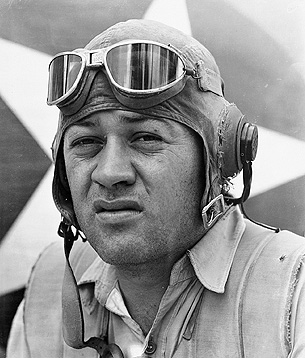
Major Gregory "Pappy" Boyington
Black Sheep Squadron C.O.
By Stephen Sherman, Jan. 2001. Updated December 14, 2016.
He returned to the States in the spring of 1942, and took up with Lucy Malcolmson; his first marriage having fallen apart. With some finagling, undoubtedly helped by the wartime demand for experienced fighter pilots, he was reappointed to the U.S. Marines in November, with the rank of Major. In January, 1943, he embarked on the Lurline, bound for New Caledonia, where he would spend a few months on the staff of Marine Air Group (MAG)-11. Here, he got his first close look at a Corsair, flown by his friend Pat Weiland.
Boyington finally secured assignment to VMF-122 as Executive Officer for a combat tour; as usual, he clashed with his superior, this time Major Elmer Brackett.
In the event, Brackett was shortly removed, and Boyington took over, but did not see much action. It was at this time, early 1943, when as the new CO of VMF-122, his claim of six kills with the AVG first made it into print.
Smoak relieved him of his command of VMF-122 in late May, followed by a broken leg and time in the hospital.
Black Sheep
In the summer of 1943, as Boyington convalesced, the US naval air forces needed more Corsairs in the fight. Oddly, the key pieces - trained pilots and operational aircraft - were present in the South Pacific, but many of them were dispersed. Who got the idea remains unclear (characteristically Boyington claimed credit), but he was given the assignment to pull together an ad hoc squadron from available men and planes. Originally, they formed the rear echelon of VMF-124.
Black Sheep Pilots
In August of 1943, these 26 pilots, who would become the famous "Black Sheep" included:
- 8 pilots had flown with Greg in VMF-122: Stan Bailey, Hank Bourgeois, Robert Ewing, Paul "Moon" Mullen, John Begert, Sandy Sims, Bill Case, and Virgil Ray. All but Lt. Ray had already downed at least one Japanese plane.
- Allan McCartney - 4 kills with a couple Marine squadrons
- Bob McClurg - originally with VMF-124
- Chris Magee, Bill Heier, Don Moore - all had flown with the RCAF
- John Bolt, Ed Olander, Rollie Rinabarger, George Ashmun - former 'plowback' instructors in the States
- 8 First Lieutenants with no Corsair experience - Bob Bragdon, Tom Emrich, Don Fisher, Denmark Groover, Walter "Red" Harris, Ed Harper, Jim Hill, and Burney Tucker
- 2nd Lt. Bruce Matheson
In a complex, and common, wartime shuffling of designations, Boyington's team was redesignated VMF-214, while the exhausted pilots of the original VMF-214 (nicknamed the Swashbucklers) were sent home. Again, Bruce Gamble, the authoritative historian of these events, provides detailed answers in his book The Black Sheep ... Marine Fighting Squadron 214 ..., which fully chronicles both squadrons that used the number 214.
Under Boyington as CO and Major Stan Bailey as Exec, they trained hard at Turtle Bay on Espritu Santo, especially the pilots who were new to the Corsair. Two other noted officers rounded out the squadron: Frank Walton, a former Los Angeles cop, became the Air Combat Intelligence Officer (ACIO), and Jim Reames the squadron doctor. (Walton would later author Once They Were Eagles ....) While leading this group of young pilots, most in their early 20's, Boyington - at the advanced age of 30! - picked up the nickname 'Gramps'. (The Black Sheep don't remember calling him 'Pappy'; that was a nickname that the press picked up after he was shot down.)
The Russells
In early September, 1943, the new VMF-214 moved up to their new forward base in the Russells, staging through Guadalcanal's famed Henderson Field.
The "Black Sheep" fought their way to fame in just 84 days, piling up a record 197 planes destroyed or damaged, troop transports and supply ships sunk, and ground installations destroyed in addition to numerous other victories. They flew their first combat mission on September 14, 1943, escorting Dauntless dive bombers to Ballale, a small island west of Bougainville where the Japanese had a heavily fortified airstrip. They encountered heavy opposition from the enemy Zeros. Two days later, in a similar raid, 'Pappy’ claimed five kills, his best single day total. In October VMF-214 moved up from their original base in the Russells to a more advanced location at Munda. From here they were closer to the next big objective -- the Jap bases on Bougainville. On one mission over Bougainville, according to Boyington’s autobiography, the Japanese radioed him in English, asking him to report his position and so forth. Pappy played along, but stayed 5000 feet higher than he had told them, and when the Zeros came along, the Black Sheep blew twelve of them away. (The absolute veracity of Boyington’s autobiography is not certain, but that’s how he told the story.) One night with a quarter moon, he went up to try to deal with "Washing Machine Charlie," but without results.
During the period from September 1943 to early January 1944, Boyington destroyed 22 Japanese aircraft. By late December, it was clear that he was closing in on Eddie Rickenbacker’s record of 26 victories (including his questionable 6 with the AVG), and the strain was starting to tell. On Jan. 3, 1944, Boyington was shot down in a large dogfight in which he claimed three enemy aircraft, and was captured.
Prisoner of War
He landed in the water, badly injured. After being strafed by the Jap fighters, he struggled onto his raft until captured by a Jap submarine several hours later. They took him first to Rabaul, where he was brutally interrogated. Even the general commanding Japanese forces at Rabaul interviewed him. Pappy related in Baa Baa Black Sheep, that the general asked him who had started the war. After Pappy replied that of course the Japanese had started the war by attacking Pearl Harbor, the general then told him this short fable:
"Once upon there was a little of old lady and she traded with five merchants. She always paid her bills, and got along fine. Finally the five merchants got together, and they jacked up their prices so high the little old lady couldn't afford to live any longer. That's the end of the story." The general left the room, leaving Boyington to ponder that there had to be two sides to everything.
After about six weeks, the Japanese flew him to Truk. As he landed there, he experienced one of the early carrier strikes against Truk in February, 1944. Along with six other captured Americans, he was confined in a small, but sturdy wooden cell - which might have been designed for one inmate. The only opening was a six-inch hole in the floor, for relieving themselves. With six men in a tiny cell, this was unpleasant enough. But when the Japs actually overfed them with rice balls and pickles, diarrhea resulted, and then the situation became really messy.
He eventually moved to a prison camp at Ofuna, outside of Yokohama. His autobiography relates the frequent beatings, interrogations, and near starvation that he endured for the next 18 months. The guards, whose only qualification seemed to be passing "a minus-one-hundred I.Q. test," beat the prisoners severely, for any infraction, real or imagined.
He lost about 80 pounds, and described how he once entirely consumed a "soup bone the size of my fist" in just two days, a feat which previously he would not have believed a dog could achieve. During the middle period of his captivity, he had the good fortune to be assigned kitchen duty, Here, a Japanese grandmother who worked in the kitchen befriended him and helped him filch food. Before long, he returned to his pre-captivity weight. He even got drunk on New Year's Eve, begging a little sake from each of the officers. From Camp Ofuna, he witnessed the first B-29 raids, striking the nearby naval base at Yokohama.
Records and Medals
When he was repatriated, he found he had been awarded the Medal of Honor and the Navy Cross. He also added to his claims for aerial victories after his return. Several other pilots had seen him down one Zero, which raised his total to 20 with the Black Sheep, and 26 if his claims for 6 with the Flying Tigers were included. 26 was Eddie Rickenbacker's WWI record, and also the number shot down by Joe Foss, the top-scoring Marine pilot of all time. Back in the States, in September of 1945, he claimed to have shot down two more planes in that final battle. Frank Walton, the ACIO, prepared the combat report, and Boyington signed it. As Bruce Gamble put it in Black Sheep One, "With a stroke of his own pen, Boyington was credited with twenty-eight victories, making him the high scoring ace in the Marine Corps." At the time, Boyington was being feted in a national War Bond Tour, patriotic feelings were running high, and he was a national hero. No one challenged the two additional claims. In all, Gamble makes a convincing case that Boyington's claims should be 22: 20 with the USMC and 2 with the AVG.
Postwar Hero?
Pappy lived until 1988, but it was a hard life, marked by financial instability, divorces and marriages, and battles with alcoholism. (I must say that, whatever his problems, Pappy never seemed to lack for attractive female companionship.) Things started downhill on his War Bond tour, when he was frequently drunk, and on one infamous occasion embarrassed himself, the Corps, and the audience with a rambling drunken speech. After a brief attempt at collaboration, had a falling out with Frank Walton. His tangled affair with Lucy Malcolmson (still married to Stewart Malcolmson) broke up, quite publicly, when he took up with Frances Baker, who became his second wife. Now a PR liability, the Marine Corps placed Boyington on the retired list in 1947, allegedly for medical reasons.
He moved from job to job, never able to stay with any one thing. He frequently refereed at wrestling matches. After a continued decline into alcoholism, he went on the wagon in 1956, and even joined AA. Things picked up for him in 1958 with the success of his memoirs, Baa Baa Black Sheep. He met Dee Tatum the next year, soon divorced Frances, and married Dee (his third). The 1960's were a real low period for Pappy, including estrangement from his own children.
Of course, Pappy's greatest fame came in the mid Seventies, when the television show "Baa Baa Black Sheep" appeared. Based very loosely on Boyington's memoirs, the show had a three-year run, and achieved a consistent popularity in re-runs. Pappy was a consultant to the show, and got on well with its star, Robert Conrad. But the show's description of the Black Sheep pilots as a bunch of misfits and drunks, which Pappy happily went along with, destroyed Pappy's friendship with many of his squadron veterans, especially Frank Walton. The show made Pappy a real celebrity, and along with his fourth (!) wife Jo, he made a good career out of being an entertainer - appearing at air shows, on TV programs, etc.
After a long battle with cancer, Pappy died on .