
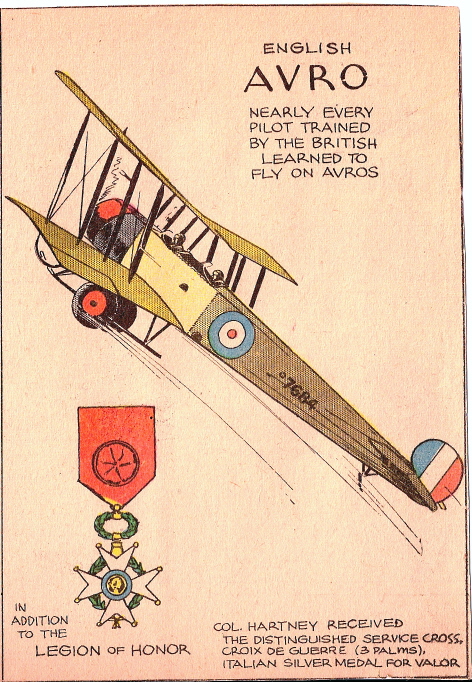
Avro 504
widely used British trainer of World War One
By Stephen Sherman, March, 2007. Updated March 23, 2012.
Produced by Alliott Verdon Roe, Britain's great pioneering aircraft designer, the Avro 504 trained nearly every British pilot in the Great War; over 8,000 were built. Especially suitable for the purpose of training pilots, it was the standard training machine of the Royal Air Force. The plane's diagnostic feature is the the big wing skid, hanging down between the wheels; it served to protect the prop if landing with the tail too high.
Roe began building planes in 1906, he became the first Englishman to fly, at Brooklands in July 1908.
After considerable experimentation with biplanes and triplanes, Roe produced the E500 biplane in 1912 that met with War Department approval; 12 were ordered within a year. The Avro 504 developed directly from the E500 machine. It moved rapidly into production, first flying in July, 1913. A graceful, two-seater biplane, it's equal-span wings balanced the fuselage, whose box-girder body blended into to the circular housing for the 80 HP Gnome rotary engine. The 504 took fourth place in the Second Aerial Derby on September 20, flying at 66.5 MPH.
As war loomed in 1914, the War Department ordered twelve Avro 504s
and even more after hostilities started. A 504 achieved the unenviable
distinction of being the first English aircraft shot down in combat,
when Lt. V. Waterfall of No. 5 Squadron, flying an Avro 504 over
Belgium went down under infantry fire.
The Friedrichshafen Raid
Avro 504 biplanes participated in a more successful event on Nov. 21, 1914 when Sqn. Cdr. E.F. Briggs, Flt Lt. S.V. Sippe, and Flt. Cdr J.T. Babbington led some RNAS machines on a bombing raid on the Zeppelin sheds at Lake Constance. At 09:30 AM, three brand-new, untested Manchester-built machines, flown by Briggs (in a/c number 874), Babington (873) and Sippé (875), took off from Belfort, France. Avro 504 piloted by Flt Sub-Lt R P Cannon broke its tailskid and was forced to abort. Flying around neutral Switzerland, the three machines flew over Lake Constance to Friedrichshafen, a distance of 125 miles, and caught the Germans completely unawares, dropping 20-lb pounds. I imagine the "guy in back" tossing them over the side like deadly grapefruits. It was a sensational raid, although the Germans were secretive about the damage they suffered. Briggs was shot down when flying low over the sheds; he was taken prisoner and managed to escape two year later. His companions completed the round trip in about four hours. All three pilots were awarded the Distinguished Service Order, Gazetted on 1 January 1915.
Like the story of any aircraft, the story of the Avro 504 is the
story of its development through many letter-denoted variants: 504A
through 504R. (The plain "504" signified the 1914 protoype and first
production version.) The 504K was the main production version,
with thousands built.
Avro 504A
Like the 504, retaining the 80-hp Gnome, but with shorter ailerons
for better downward visibility. Several hundred were produced. Records
are incomplete, but the total number of 504As and 504Js totalled 1,455.
The 504A was the main production version of 1915-16.
Avro 504B
A naval version produced for the Admiralty, 240 built. Also used the
80-hp Gnome, but reverted to the larger ailerons. The 504B introduced
the tailskid, a large piece of ash wood, sprung with a rubber cord, and
hinged to a pylon underneath the tail. All later 504s retained this
tailskid.
Avro 504C
A single-seat version, also produced for the RNAS, eighty of these
were built. A big fuel tank in place of the front seat permitted a
increase (over 2X) in endurance to 8 and 1/2 hours. The upper
wing was notched to
permit an upward-firing Lewis gun. (The 504D designated a similar model
for the RFC.)
Avro 504E
Another naval model, the 504E mounted the more powerful 100-hp Gnome
Monosoupape engine. With this extra power, the Navy could squeeze in
the extra fuel tank between the two seats. (The 504F, 504G, and 504H
were not produced in large numbers.)
Avro 504J
This was the first of the large-scale production versions (along
with the 504K). Several hundred were built. The 504J externally
resembled the 504A; the difference lay under the hood, where a 100-hp
Gnome drove the Avro. Another significant innovation of the 504J was
the Gosport speaking tube, which enabled the flying instructor to
communicate (shout) to the student. "No, no, no, you ninny. I said pull up on the stick."
Avro 504K
The definitive version of the Avro 504, with 6,350 produced. The key
feature of the 504K was its universal engine mount, designed by H. E.
Broadsmith, permitting a wide variety of rotary engines to be installed:
- 90-hp RAF 1A and Thulin
- 100-hp Gnome Monosoupape, Curtiss K6, and Sunbeam
- 110-hp Le Rhône
- 130-hp Clerget
- 150-hp Bentley BR1
- 170-hp ABC Wasp
- 220-hp Hispano-Suiza
At the peak of wartime production, Avro planned on building 100 per
week, as well as 20 sets of parts for assembly in Egypt. 52 were sold
to the American Expeditionary Forces as trainers.
The advantages that the 504 had over previous trainers were numerous. It carried a rotary engine, vital to familiarize flying students. The 504K, introduced in 1917, sported a new type of universal engine mount which consisted of two bearer plates that could accommodate any sort of engine. Another advantage was the ease with which students and instructors could communicate in the cockpit, thanks to the "Gosport Speaking Tube". It was more robust than the delicate Farman trainer, and more manoueverable than the heavy BE2c. The 504's relatively light weight in comparison to its wing size prevented the plane from dropping dramatically when power was reduced, and the "forgiving" quality of its controls were ideal for training. So too was the skid that could be outfitted under the nose, designed to prevent tipping during landing.
Specifications of the Avro 504K:
- Engine: 110hp Le Rhône rotary engine
- Absolute Ceiling: 16,000 feet
- Wingspan: 36 feet
- Length: 29 ft 5 in
- Height: 10 ft 5 in
- Wing area: 330 sq ft
- Weight: 1,230 lb. empty; 1,829 lb. maximum take-off
| Component |
Weight,
lbs. |
| Tail unit: tail plane with supports,
elevators, and rudder with levers and wires |
42 |
| Main lift
structure: wings, flaps, interplane struts and wires |
326 |
| Landing
gear: undercarriage, axle, wheeels, wing skids, and tail skid |
113 |
| Fuselage: body and engine housing,
control gear and wires, flying instruments, lights, etc. |
325 |
| Power
plant: 110 hp Le Rhône engine, magnetos, propeller, boss,
bolts, oil tanks, oil cooler, fuel tanks, air pressure system, piping |
425 |
| Total
weight of machine bare with water in radiators |
1231 |
| Crew of 2 at 180 lbs.
each |
360 |
| Petrol, 25.5 gallons |
184 |
| Oil, 6 gallons |
54 |
| Weight
of machine in flying trim |
1829 |
| Performance
of 504K, with 110 hp Le Rhône |
at Sea
Level |
at 3,500
ft. |
at 8,000
ft |
at 10,000
ft |
| Max.
speed, full power |
95 mph |
- |
87 mph |
85 mph |
| Endurance,
at full power |
2 hrs. |
- |
2.14 hrs. |
3 hrs. |
| Estimated
climb, at full power |
- |
5 mins. |
10 mins. |
16 mins. |
| Est.
speed, at 3/4 power |
- |
- |
74 mph |
71 mph |
| Endurance, at 3/4 power | - |
- |
3.7 hrs. |
4.25 hrs. |
Avro 504N
Production of the Avro 504 was spread out among many different firms:
- A. V. Roe and Co Ltd, Park Works, Newton Heath, Manchester; and at Hamble Aerodrome, near Southampton, Hants.
- Australian Aircraft and Engineering Co Ltd, Sydney, NSW, Australia
- Brush Electrical Engineering Co Ltd, Loughborough
- Canadian Aeroplanes Ltd, Toronto, Canada
- Eastbourne Aviation Co Ltd, Eastbourne
- Grahame-White Aviation Co Ltd, Hendon Aerodrome, London
- Harland and Wolff Ltd, Belfast
- The Henderson Scottish Aviation Factory, Aberdeen
- Hewlett and Blondeau Ltd, Oak Road, Leagrave, Luton, Beds.
- Humber Motor Co Ltd, Coventry Morgan and Co, Leighton Buzzard, Beds.
- Nakalima Hikoki Seisaku Sho, Ohta-Machi, Tokyo, Japan
- Parnall and Sons, Mivart Street, Eastville, Bristol
- Frederick Sage and Co Ltd, Peterborough and London
- S. E. Saunders Ltd, East Cowes, Isle of Wight Savages Ltd, King's Lynn,
- Societe Anonyme Belge de Constructions Aeronautiques Haren, Brussels, Belgium
- Sunbeam Motor Car Co Ltd, Wolverhampton
- Yokosuka Naval Arsenal, Japan
Postwar Service
After the war, with as many as 3,000 surplus 504s available, noted for their easy handling, they became popular as barnstorming machines in the 1920s. Handley Page and its subsidiary Aircraft Disposal Co., sold them to the public at great discount. List price of an Avro 504K, equipped with a 130-hp Clerget was over 1,800 pounds; by 1920, a civilian could buy such an aircraft for 650 pounds. 504s performed at airshows like the Aerial Derbies, the Wakes Weeks and Air Traffic Exhibitions. The flier Alan Cobham started barnstorming with Avro 504Ks; Captain Percival Philips carried tens of thousands of thrill-seeking passengers aloft in his Avro.
In 1920, the Avro 504K was selected as the standard trainer for the Canadian Air Force and remained in service until 1928. A civil Avro 504K is credited with one of the first commerical passenger flights into the Canadian bush on 15 to 17 October, 1920. Two passengers seated in an enlarged front cockpit were flown from Winnipeg to Le Pas. An ex-Air Force 504 made the first winter flight to James Bay in 1922.
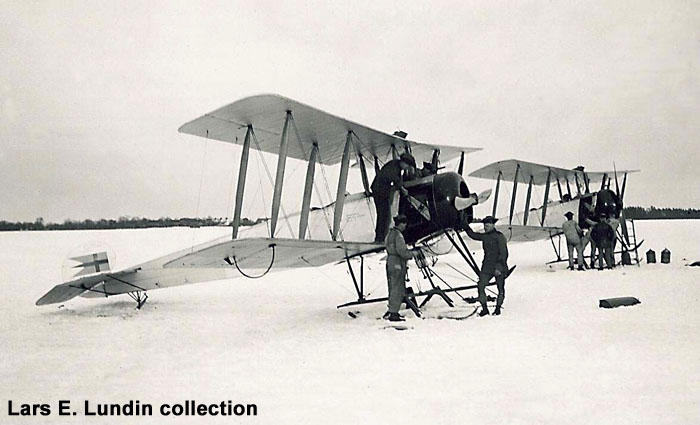
Swedish Naval Aviation ordered in 1923-24 five Avro 504Ks. The Swedish 504Ks were equipped with rotary 130 hp Clerget engines. They were used as trainers in the winter (on frozen sea) at the Navy Flying School at Hägernäs near Stockholm. The five aircraft got the Navy numbers 6-10. All five aircraft were transferred to the new Air Force in 1926. They were now based at the new War Flying School at Ljungbyhed. The new designation was Sk 3. In December 1925, the Army Aviation Company ordered an Avro 504N, an improved aircraft with a number of structural revisions, an improved landing gear that eliminated the central skid of earlier models, and powered with the stronger Armstrong Siddeley Lynx IV engine. This engine delivered 170 hp and eliminated the disadvantages of a rotary engine. The 504s (or Sk 3s) had a short career in Sweden. A 504N was destroyed after only one year of service. In April, a 504 crashed and had to be written off. The pilot of another crashed fatally in the end of 1927. Two more were written off in the beginning of 1928 after crashes. The last tow were written off in the summer of 1928 due to wear. Photo: Two Avro 504K:s with the Navy numbers 6 and 7 at Malmslätt, probably in 1925.
Sources:
 British and Empire Aces of World War I, by
Christopher Shores
British and Empire Aces of World War I, by
Christopher Shores
No. 45 of the Osprey Aircraft of the Aces series. Thirty-six colorful profile plates of many types of aircraft, including Airco D.H.2, Bristol Scout, Spad S.VII, Sopwith Pup, S.E.5a, Nieuport 17, Sopwith Triplane, Bristol F.2B, Airco D.H.5, Nieuport 23, Nieuport 27, Sopwith Camel, Sopwith Dolphin, and Sopwith Snipe. Many original period photos, including a unique one of King George V inspecting RAF pilots (Ira 'Taffy' Jones among them) in August, 1918. After a chronological summary of British aerial combat in World War One, the book offers short biographies of over 50 Empire pilots: from England, Scotland, Wales, Ireland, Canada, South Africa, New Zealand, and Australia. |
 |