
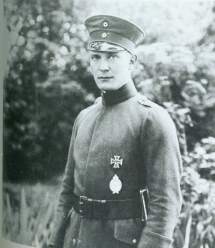
Hermann Göring
German Ace of WWI, CO of Richthofen Group
Head of Luftwaffe and Hitler's Right-Hand Man in WWII
By Stephen Sherman, Aug. 2001. Updated April 15, 2012.
It is impossible to consider Hermann Göring (frequently rendered as Herman Goering) as just another flying ace of World
War One. His role in instigating and perpetrating the horrors of Naziism in World War Two overwhelms anything else he did earlier in his life. While this article focuses on his WWI experiences, his heinous role in WWII can never be forgotten.
Background
Hermann Goering was born in Rosenheim, Bavaria, in 1893. His father was a professional soldier who rose to be the first governor of German West Africa (modern-day Namibia, where one of the main streets in the capital is still Goringstrasse). Young Hermann grew up in friends' homes and in military schools while his parents were abroad. (Historians and amateur psycho-analysts have had a field day attributing Göring's adult evil to his childhood without parental love. Of course, Winston Churchill's youth was about the same.)
Without question, Göring was an undisciplined and reckless youth, but he fit into the rigid structure of military life. He was commissioned a second lieutenant in 1912, and was assigned to Alsace where he formed a cyclist corps. By 1915, he was hospitalized for rheumatism; a visit by his friend Bruno Loerzer (a future 41-victory ace) persuaded him to join the air corps. He essentially deserted his infantry unit, and assumed the role of Loerzer's observer. He and Loerzer both won the Iron Cross, First Class, for their reconnaissance work. He flew with Loerzer until the spring of 1916, when he went to pilot training school at Courtrai. Göring claimed he already knew how to fly and "borrowed" a Rumpler that he flew to the front. In short order, he was assigned to a fighter staffel near Verdun.
Staffel 5
Göring's unit was Staffel 5, flying Fokkers (E.IIIs?) with his friend Bruno Loerzer. By the end of 1916, he was credited with three French airplanes and with saving Bruno's life. When Loerzer's machine gun wouldn't fire, two Nieuports pounced on him. Goering saw this and drove off both Frenchmen, destroying one of their aircraft.
In mid-February, 1917, he got separated from his flight one day and went after a twin-engine biplane. After he knocked out one of its engines, a flight of Spads showed up and attacked. He fought them for fifteen minutes as he flew all-out for the German lines. The Spads shot up him and his aircraft quite badly, but he managed to land near a field hospital, where prompt treatment probably saved his life. (What a shame, one cannot help but observe. How much agony would the world have been spared if Göring and a certain German corporal had been killed in World War One?)
But he did survive, and returned to action in a couple months. In May, Loerzer reciprocated and saved Goering one day when his propeller was shot away; Loerzer covered him until he could land at an advance airfield. By the end of May, Göring had accumulated seven aerial victories.
Jasta 27
In June, 1917, Göring was given command of Jagdstaffel 27, a unit made of new graduates of flying school.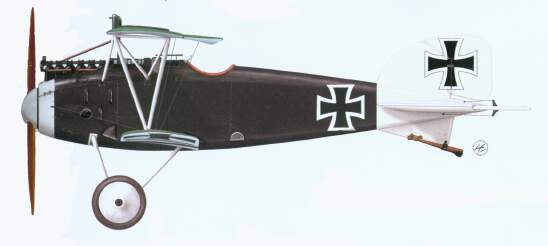
Within a few days of joining Jasta 27, Goering was leading a flight of ten planes over Arras when they encountered a group of British Nieuports. Göring dived after one Nieuport and soon found himself in trouble as the Nieuport began to shoot him up. But he got in a lucky burst and Englishman went down on the German side. A week later Göring scored his tenth kill when he met some FE's and Camels above Cambrai. After destroying an FE, another flight of Sopwiths came on and shot down one of his Albatroses. Göring knocked down another one of the Camels before even more arrived, at which point he led his Albatroses home. By the end of 1917, he had sixteen claims.
1918
Göring started the year on a near-disastrous note, when the gunner in a British F.E.2b riddled his fuel tank and sent him spinning earthwards. Some other Albatroses from his squadron saved him again. He had another close encounter in February when Lt. W.B. Craig, a five-victory Sopwith pilot, shot up Göring's Albatros. Once again, luck rather than skill seemed to be with Göring, and he shot down Craig.
By June he had run his score to 21, and won the Ordre pour le Mérite.
Richthofen Group
Göring was appointed head of the Richthofen Group in July, much to annoyance of many aces in that group with 40+ kills. But Göring turned out to be a good group leader and the complaints faded away and morale improved. He shot down one more Spad for his 22nd and final victory. The respected historian and author, Norma Franks, noted that many of Goring's kills seem to have occurred over British lines, a rather suspicious circumstance.
When the war ended, J.G. Richthofen was ordered to Darmstadt. When the group arrived there, the city was in the hands of revolutionaries, who captured some of the planes' weapons. Goering faced down the rebels, threatening to bomb and strafe the town if the arms were not returned. The revolutionaries complied.
Later Years
In the 1920's Göring went to Sweden and flew for an air transport company. He met Adolf Hitler and became a leader of the Nazi Party in the 1930's. He became the second most powerful man in the Third Reich and Hitler's heir apparent, Minister of Aviation and head of the Luftwaffe. He managed to avoid blame for the Luftwaffe's failures, notably the Battle of Britain and the aerial resupply of the German Sixth Army at Stalingrad.
Göring indulged himself fully in the power and pleasures of his position. he loved fancy uniforms and medals of all types. He filled his estate, Karinhall, with art treasures looted from all over Europe. Some of his quotes were quite memorable. In the early part of the war, he remarked, "If Allied planes ever bomb Berlin, you can call me Meyer." Later on they did, escorted by P-51 Mustangs, he observed, "When I saw Mustangs over Berlin, I knew the jig was up."
He was convicted of war crimes at the Nuremburg trials in 1946. Condemned to death, he cheated the hangman by swallowing cyanide.
Sources:
- The Aerodrome
- Heroes of the Sunlit Sky, by Arch Whitehouse, Doubleday, 1967
- The Canvas Falcons, by Stephen Longstreet, Barnes & Noble, 1970
- Knights of the Air, by Ezra Bowen, Time-Life Books, 1980
- Rand McNally Encyclopedia of Military Aircraft: 1914-1980, by Enzio Angelucci, The Military Press, 1983