The following decorations were awarded for actions in combat or in aerial flight:
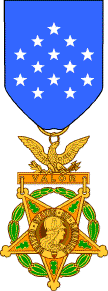
Well known as the country's highest decoration for
valor. 3,549 have
been awarded since 1863. 464 awarded in World War Two, including 37 to
members of the USAAF, 2 Navy aces (Butch
O'Hare - for whom the airport is named, and David McCampbell), and 9 USMC aces. Read more detail on WW2 aces that received the
Medal of Honor. At least one Marine bomber pilot, Richard Fleming,
also received the MOH. There are a couple points of terminology worth noting. First, it is
not the "Congressional" Medal of Honor. The President awards the MOH
"in the name of Congress," but it is simply the "Medal of Honor."
Second, the MOH is not "won," nor are the recipients "winners." It is
awarded to or received by "recipients."
Medal of Honor
Awarded "For Conspicuous Gallantry and Intrepidity at the Risk of Life,
Above and Beyond the Call of Duty, in Action Involving Actual Conflict
with an Opposing Armed Force." Established 1862.
Many of the high-scoring USAAF aces in World War Two (Gabreski,
Johnson, Preddy, Meyer, MacDonald, Robbins, Voll, et al) earned a DSC.
After the Air Force became a separate service, the Air Force Cross
replaced the DSC for airmen.
Army Air Corps ace George "Wheaties" Welch received the DSC for his
actions at Pearl Harbor:
Original World War Two Distinguished Service Crosses (not replicas)
have sold on Ebay for $50, $100, or more.
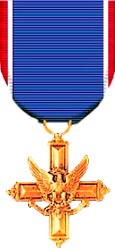
Distinguished Service Cross
For "Extraordinary Heroism in Connection with Military Operations
Against an Opposing Armed Force." Established 1918.
"He immediately, on his own initiative, took off ...
armed only with 30-caliber machine guns. [When] he observed a formation
of approximately 12 planes ... he attacked and shot down an enemy dive
bomber with one burst from three guns. At this point he discovered that
one gun was jammed [and] his plane was hit by an incendiary bullet,
which passed through the baggage compartment just in rear of his seat."
Welch shot down another plane before he ran low on fuel. He landed at
Wheeler Field to refuel and replenish his ammunition, then "immediately
took off, headed straight into the attack [of a second wave of 15
planes] to the assistance of a brother officer who was being attacked
from the rear." Welch shot down at least four planes that day even
though his plane had "bullets striking his motor, propeller and
cowling."
One WWII Navy flier who received the Navy Cross was Ensign Leslie
Lockhart Bruce Knox, an Australian who was serving with the USN. After
the Battle of the Coral Sea, he was posthumously promoted to Lieutenant
(jg) on 25 June 1942 and awarded the Navy Cross. The Citation read: Includes sections on Navy insignia, ranks, rates, & ratings,
sleeve devices, service stripes, specialty marks, identification
badges, wearing ribbons and medals, foreign decorations, aiguillettes,
brassards, buttons, placement of devices, commemorative medals, etc.
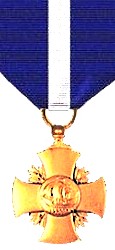
Navy Cross
"Awarded to any person while serving in any capacity with the Navy or
Marine Corps who distinguishes himself with extraordinary heroism not
justifying the award of the Medal of Honor, ... while engaged in an
action against an enemy of the United States; ... To warrant this
distinctive decoration the act should involve risk of life so
extraordinary as to set this person apart from his contemporaries."
Established in 1919.
"For extraordinary heroism and conspicuous courage as
pilot of an aircraft in a fighting squadron in action against enemy
Japanese forces in the Battle of the Coral Sea. On that evening, as one
of the fighters launched to oppose enemy Japanese aircraft in the
vicinity of his ship, Ensign Knox attacked a formation of seven enemy
aircraft, shooting down one and assisting in the action which resulted
in dispersing the others. In this engagement he displayed unusual skill
and devotion to duty, carrying out his mission with determination and
aggressiveness against great enemy odds and with complete disregard for
his own personal safety. He failed to return from this action."
Decorations,
Medals, Ribbons, Badges and Insignia of the United States Navy: World
War II to Present by James G. Thompson.
It's difficult to find the total number of Silver Star, or other
medals, awarded in World War II. Here are a few random statistics of
Silver Star recipients: Lt. Gerard J. Fannick, a co-pilot in a B-17 in the Mediterranean
earned a Silver Star. His commendation follows:
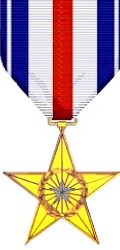
Silver Star
"For Gallantry in Action Against an Opposing Armed Force." Established
1918.
"For extraordinary gallantry in action while
participating in aerial flight as Copilot of a B-17 on 16 February 1945
in the Mediterranean Theater of Operations. As Lieutenant Flannick's
aircraft was completing its bomb run on the railyards at Bolzano, Italy
it was fatally struck by enemy anti-aircraft fire. Lt. Flannick,
although told by his pilot to bail out, courageously stayed at the
controls of his aircraft to maintain its track on the bomb run and to
give his crew time to bail out. Lt. Flannick knew, that as the Deputy
Group and Squadron Lead, the other bombers would drop their bombs on
his lead and that if he failed to do so, in all likelihood the target
would be missed, adversely affecting the war effort. Moreover, he knew
that if the aircraft fell out of the control, his fellow airmen would
not be able to safely exit the plane, so with complete disregard for
his own safety, he fought the controls, until after bomb release and
his men exited the plane. Subsequent events revealed a successful
strike on target and the safe landing of eight of his crew. Lt.
Flannick and his flight engineer perished. Lt. Flannick's gallant,
selfless and voluntary action in the face of great danger, which
resulted in the loss of his own life reflects great credit on him and
the Armed Forces of the United States."
The Eighth Air Force awarded 41,000 DFC's. Presumably, based on
those numbers, virtually all 8AF aces received a DFC. Capt. Gerard F. Wientjes, piloting a PBY Catalina earned a DFC for
his dramatic resuce of downed airmen in New Guinea:
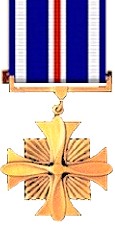
Distinguished Flying Cross
"For Heroism or Extraordinary Achievement while Participating in Aerial
Flight." Established 1926
"For extraordinary achievement while participating in an
aerial flight over Dutch New Guinea on 31 July 1944. Captain Wientjes
was the pilot of a Navy Catalina aircraft dispatched to rescue an air
crew down at a lake in enemy territory. When he arrived over the lake
he could see, from the bodies of Japanese soldiers lying about, that
there had been a recent engagement. Fully realizing the vulnerability
of the Catalina to possible enemy small arms fire, he landed without
damage amid thick underwater grass, logs, and other debris and taxied
to the very edge of the shore. He arranged for the necessary protection
against probably hostile patrols and proceeded to direct the rescue of
10 men, 7 of whom were badly wounded. All of them were put into a life
raft, then brought aboard the plane. After the crew had freed the
wheels from the entangled grass and pushed the Catalina away from the
shore to prevent it from running aground, he attempted a take off but
failed because the load was excessive and the surface of the water was
glassy. After all the gasoline that could be spared was dumped off, he
made a successful takeoff in semi-darkness and brought the rescued
personnel to a base where they were taken to a hospital. The
outstanding courage and devotion to duty displayed by Captain Wientjes
during this flight are in keeping with the highest traditions of the
United States Army Air Forces."
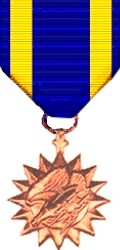
Description: A bronze compass rose 1 11/16 inches
circumscribing diameter and charged with an eagle volant carrying two
lightning flashes in its talons. A fleur-de-lis at the top point holds
the suspension ring. The points of the compass rose on the reverse are
modeled with the central portion plain for engraving the name of the
recipient.
Ribbon: The ribbon is 1 3/8 inches wide and consists of the
following stripes: 1/8 inch ultramarine blue 67118; ¼ inch
golden orange 67109; center 5/8 inch ultramarine blue; ¼ inch
golden orange; and 1/8 inch ultramarine blue.
The Eighth Air Force awarded 442,000 Air Medals in WW2.
One Captain James Hunter, a B-24 pilot with the 491st Bombardment
Group, 854th Squadron, earned an Air Medal, which read in part: "For
meritorious achievement in accomplishing with distinction several
aerial operational missions over enemy occupied Continental Europe. The
courage, coolness and skill displayed by this individual in the face of
determined opposition, materially aided in the successful completion of
these missions. His actions reflect great credit upon himself and the
Armed Forces of the United States".
Air Medal
"For Meritorious Achievement while Participating in Aerial Flight."
Established 1942.
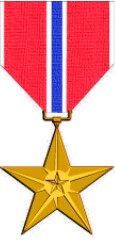
Description: A bronze star 1 ½ inches in
circumscribing diameter. In the center thereof is a 3/16-inch diameter
superimposed bronze star, the center line of all rays of both stars
coinciding. The reverse has the inscription "HEROIC OR MERITORIOUS
ACHIEVEMENT" and a space for the name of the recipient to be engraved.
The star is suspended from the ribbon by a rectangular shaped metal
loop with the corners rounded.
Ribbon: The ribbon is 1 3/8 inches wide and consists of the
following stripes: 1/32 inch white 67101; 9/16 inch scarlet 67111; 1/32
inch white; center stripe 1/8 inch ultramarine blue 67118; 1/32 inch
white; 9/16 inch scarlet; and 1/32 inch white.
Original WWII Bronze Star medals have sold for $15 or more on Ebay.
Bronze Star
"For Heroic or Meritorious Achievement of Service, not involving aerial
flight, in connection with Operations Against an Opposing Armed Force."
Established 1944.
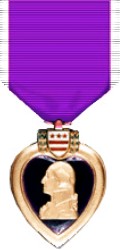
The United States had 671,000 wounded in the Second World War; all
were eligible for the Purple Heart.
Original WW2 Purple Heart medals (in good condition, with the case,
etc.) have sold for over $50 on Ebay.
Purple Heart
"For being wounded in action in any war or campaign." Thus designated
by FDR in 1942, although the decoration had existed previously.
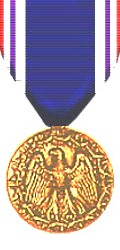
Department of Defense Prisoner of War/Missing Personnel Office
(DPMO) estimates that 157,700 U.S. servicemen were captured in WW2:
Germany, 130,200; Japan, 27,500; all eligible for the POW medal. The
U.S. Army Air Forces, in the air war against Germany suffered 51,106
POWs, MIA's, evaders, and internees.
All requests for the POW Medal will be initiated by eligible former
POWs, or their next of kin, using a personal letter or DD form 2510
(prisoner of War Medal Application/Information). Applications should be
forwarded to the Commander, ARPERCEN, ATTN: DARP-VSE-A, 9700 Page
Boulevard, St. Louis, M0 63132-5200.
Prisoner of War Medal
"Authorized for all US Military Personnel who were Taken Prisoner of
War ... during an Armed Conflict, and who Served Honorably during the
Period of Captivity." Established 1985.
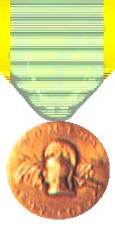
Description: A bronze medal, 1 ¼ inches in diameter,
with the head of Pallas Athene in profile facing right, superimposed on
a sheathed sword cross with oak leaves and a palm branch within a
circle composed of the words "WOMEN’S" in the upper half, and in the
lower half "ARMY CORPS". On the reverse, within an arrangement of 13
stars, is a scroll bearing the words "FOR SERVICE IN THE WOMEN’S ARMY
AUXILIARY CORPS" in front of the letters "U S" in lower relief. At the
top and perched on the scroll is an eagle with wings elevated and
displayed and at the bottom, the date "1942-1943."
Ribbon: The ribbon is 1 3/8 inches wide and consists of the
following stripes: 1/8 inch Old Gold 67105; 1 1/8 inch Mosstone Green
67127; and 1/8 inch Old Gold.
Women's Army Corps Service Medal
For service in the Women's Army Auxiliary Corps, later "Women's Army
Corps." in World War Two. Established 1943.
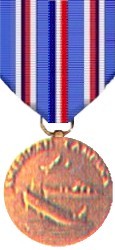
Description: The Bronze medal is 1 1/4 inches in width. On
the obverse is a Navy cruiser under full steam with a B-24 airplane
flying overhead with a sinking enemy submarine in the foreground on
three wave symbols, in the background a few buildings representing the
arsenal of democracy, above the scene the words "AMERICAN CAMPAIGN." On
the reverse an American bald eagle close between the dates "1941 -
1945" and the words "UNITED STATES OF AMERICA."
Ribbon: The ribbon is 1 3/8 inches wide and consists of the
following stripes: 3/16 inch oriental blue 67172; 1/16 inch white
67101; 1/16 inch black 67138; 1/16 inch scarlet 67111; 1/16 inch white;
3/16 inch oriental blue; center 1/8 triparted old glory blue 67178,
white and scarlet; 3/16 inch oriental blue; 1/16 inch white; 1/16 inch
scarlet; 1/16 inch black; 1/16 inch white; and 3/16 inch oriental blue.
American Campaign Medal
For service in the US Armed Forces within the American Theater of
Operations
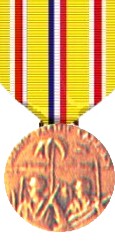
Description: The bronze medal is 1-1/4 inches in width. On
the front is a tropical landing scene with a battleship, aircraft
carrier, submarine and an aircraft in the background with landing
troops and palm trees in the foreground with the words "ASIATIC PACIFIC
CAMPAIGN" above the scene. On the reverse, an American bald eagle close
between the dates "1941 - 1945" and the words "UNITED STATES OF
AMERICA."
Ribbon: The ribbon is 1 3/8 inches wide and consists of the
following stripes: 3/16 inch yellow 67108; 1/16 inch white 67101; 1/16
inch scarlet 67111; 1/16 inch white; ¼ inch yellow; center 1/8
triparted old glory blue 67178, white and scarlet; ¼ inch
yellow; 1/16 inch white; 1/16 inch scarlet; 1/16 inch white; and 3/16
inch yellow.
Asiatic-Pacific Campaign Medal
For service in the US Armed Forces within the Asiatic-Pacific Theater
of Operations
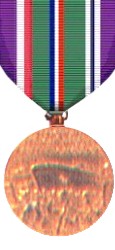
European-African-Middle Eastern Campaign Medal
For service in the US Armed Forces within the European-African-Middle
Eastern Theater
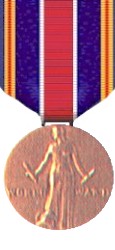
Description: The bronze medal is 1 3/8 inches in width. On
the front is a figure of Liberation standing full length with head
turned to dexter looking to the dawn of a new day, right foot resting
on a war god’s helmet with the hilt of a broken sword in the right hand
and the broken blade in the left hand, the inscription "WORLD WAR II"
placed immediately below the center. On the reverse are the
inscriptions "FREEDOM FROM FEAR AND WANT" and "FREEDOM OF SPEECH AND
RELIGION" separated by a palm branch, all within a circle composed of
the words "UNITED STATES OF AMERICA 1914 1945."
Ribbon: The ribbon is 1 3/8 inches wide and consists of the
following stripes: 3/8 inch double rainbow in juxtaposition (blues,
greens, yellows, reds (center), yellows greens and blues); 1/32 inch
White 67101; center 9/16 inch Old Glory Red 67156; 1/32 inch White; and
3/8 inch double rainbow in juxtaposition. The rainbow on each side of
the ribbon is a miniature of the pattern used in the WWI Victory Medal.

World War II Victory Medal
For service in the US Armed Forces between 07 Dec 1941 and 31 Dec 1946.
The 32nd Infantry Division, "The Red Arrow," earned 11
Medals of Honor, 157 Distinguished Service Crosses, 845 Silver Stars,
49 Legion of Merit, 78 Soldiers Medals, 1,854 Bronze Stars, 11,500
Purple Hearts, and 98 Air Medals.
During World War Two, the 101st Airborne Division spent 214
days in combat. In addition to 2 Medals of Honor awarded to Soldiers of
the 101st, the Division awarded 47 Distinguished Service Crosses, 516
Silver Stars and 6,977 Bronze Stars. Troopers of the 82d Airborne, the All Americans," were
awarded three Medals of Honor, 70 Distinguished Service Crosses, 894
Silver Star Medals, 2,478 Bronze Star Medals, and numerous foreign
decorations.
Airmen of the Eighth Air Force were awarded 17 Medals of
Honor, 226 Distinguished Service Crosses, 864 Silver Stars, 45,977
Distinguished Flying Crosses, 442,300 Air Medals, and 2,984 Bronze
Stars.
The 3rd Bombardment Group (of the Fifth Air Force) had
established an impressive record. Its personnel had earned a Medal of
Honor, 37 Distinguished Crosses, 187 Silver Stars, 159 Distinguished
Flying Crosses, 17 Bronze Stars, 24 Soldiers’ Medals, 640 Air Medals
and 257 Purple Hearts. In World War II, Navy Corpsmen earned seven Medals of Honor, 61 Navy
Crosses, 465 Silver Stars, and 982 Bronze Stars. Highly Decorated Units of WW2
The 442nd Regimental Combat Team, the famed Japanese-American
"Go for Broke" unit earned more than 18,000 individual decorations
including one Medal of Honor, 53 Distinguished Service Crosses, 588
Silver Stars, 5,200 Bronze Star Medals, 9,486 Purple Hearts, and eight
Presidential Unit Citations (the nation's top award for combat units).
In June 2000, President Clinton awarded an additional 20 Medals of
Honor to members of the 100th Battalion and 442nd Regimental Combat
Team. This was the result of a re-examination of the files of dozens of
Japanese-American soldiers to see if any of them might have been denied
awards because of possible prejudice. One of these recipients was
Hawaii's U.S. Senator Daniel Inouye.
Questions? Ask in The Forum
Or check the FAQ
Copyright 2007, by Acepilots.com. All rights reserved.