
Aviation Pioneers
The Golden Age of Aviation 1919 - 1939
By Stephen Sherman, Jan. 2001. Updated June 27, 2011.
Between the World Wars was the most exciting period in aviation history.
Almost daily, pilots were breaking speed and distance records, designers were revolutionizing aircraft design, and manufacturers were building more and better planes. Barnstormers, air shows, and flying circuses fascinated the public and drew large crowds.
Oceans and continents were conquered. And at no small risk. Many brave fliers set out to fly long distances and simply disappeared, usually swallowed up without a trace in the oceans. While everyone knows of Lindbergh's New York to Paris flight in 1927, other notable trips made headlines: the first trans-Pacific flight, the first London to Melbourne, and round-the-world flights. Also, the pilots and airplane designers broke speed records: both for long distance flights (e.g. Los Angeles to New York) and short flights over measured courses, for all-out maximum speeds.
Air races, like the National Air Races in Cleveland, were an
institution. For these, designers built special racing planes,
typically
powered by radial engines, highly streamlined, resembling tapered
cylinders, sometimes with the cockpit set way back, to give the pilot
better visibility as the plane cornered around pylons at race courses.
For long-distance flights, planes like the Spirit of St. Louis featured
reliability, fuel capacity, light weight, and stability.
Like many young men of the era, my Dad was fascinated by aviation;
indeed he spent his working career at Pratt & Whitney Aircraft in
East Hartford, Connecticut. Two of his aviation collections are
included here, his photographs of
airplanes that he took at local airports, and scans of the weekly
cartoon Hall of Fame of the Air,
featuring a notable pilot and a related aircraft in the Sunday color
section of the newspaper.
| Aviators | Achievement(s) | Aircraft |
|---|---|---|
| Charles Lindbergh | first man to fly solo across the Atlantic in 1927 | Ryan monoplane Spirit of St. Louis |
| Amelia Earhart | first woman to fly across the Atlantic in 1928, died while trying round-the-world flight in 1937 |
Fokker trimotor, Lockheed Electra |
| Howard Hughes | set several aviation speed records; built major aviation companies | H-1 Racer |
| Charles Kingsford Smith | first to fly across the Pacific in 1928 | Fokker F.VII trimotor |
| Frank Hawks | first transcontinental glider flight | Franklin glider |
| Richard Byrd | first to fly over the South Pole in 1929 | Ford trimotor |
| Wiley Post | first to fly around the world in 8 days | Lockheed Vega Winnie Mae |
| Alexander de Seversky | interwar aircraft designer | SEV-3, P-35 |
| Douglas 'Wrong-Way' Corrigan | Flew solo to Ireland in 1938 | Curtis Robin |
| Quimby, Coleman, Cochran, et al | Famous Women Aviators | various |
| various |
most widely produced military
aircraft of the era |
Breguet
19 |
| various |
world's first modern airliner |
Boeing
247 |
Across the Atlantic
1919 - A. C. Read
May 16 to 31. Lt. Commander A.C. Read. U.S. Navy, and crew in Curtis flying boat NC-4, made a transatlantic flight from Newfoundland to Portugal by way of the Azores. They arrived in Plymouth, England, on May 31.
1919 - Alcock and Brown
One of the first events to grab the public's attention was the June 14, 1919 transatlantic flight of Captain John Alcock and Lieutenant Arthur W. Brown. Both had flown in World War One and had been POW's - Alcock by the Turks, Brown by the Germans.
The two British officers made the first non-stop flight across the Atlantic Ocean from St. Johns, Newfoundland to Clifton, Ireland, in about 16 hours. They flew a modified Vickers Vimy biplane bomber. The news of their flight spread quickly, and they received as heroes in London. They took the Daily Mail's prize of 10,000 pounds and were knighted by King George V. Check out the fine Long Flight website, detailing their historic flight.
1927 - Charles Lindbergh
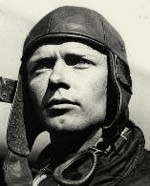
The most famous airplane flight of all time took place on May 20-21, 1927, when Charles A. Lindbergh became the first person to fly solo across the Atlantic, flying from New York Paris in a custom-built Ryan monoplane, the Spirit of St. Louis. Read about Lindbergh and his flight here.
(Today, the Spirit of St. Louis hangs in the main lobby of the National Air & Space Museum, in Washington D.C. I'll never forget the first time I walked in there, not really knowing what to expect. There, right above me - the Wright Brothers flyer, the Spirit of St. Louis, Chuck Yeager's Bell X-1, and the Apollo XI Command Module - the four most famous aircraft in history, all together, in public view. Wow! - SS)
1932 - Amelia Earhart
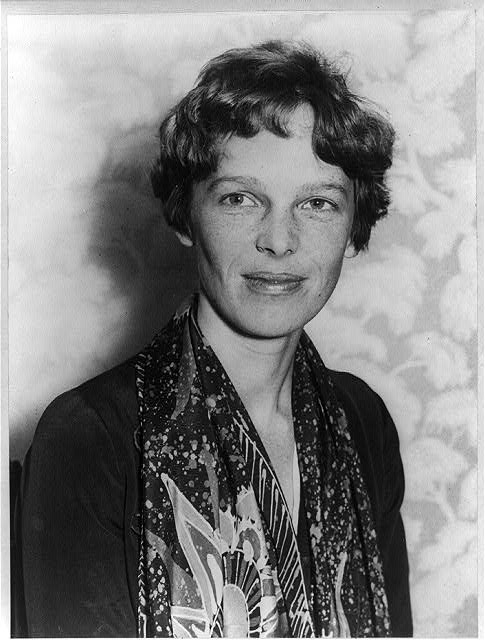
Amelia Earhart became the first woman to across the Atlantic on June 18-19, 1928. While the flight garnered her a lot of publicity, she was little more than a passenger in the Fokker tri-motor "Friendship." In 1932, five years to the day after Lindbergh's solo flight across the Atlantic, she duplicated the feat - the first woman, and only the second person to do so at that time. In 1937, while attempting an around the world flight with navigator Fred Noonan, she disappeared over the Pacific. Read about Earhart's life and last flight here.
Air Mail Pilots
On July 1, 1924, the U.S. Post Office started overnight airmail service between New York and San Francisco. Flying across country, over the Rocky mountains, was very dangerous, and the pilots who did the job were as brave as any combat fliers.
To the Poles
1926/29 - Richard Byrd
In 1926, Richard Byrd and Floyd Bennett flew over the North Pole in a Ford Trimotor. In 1929, Byrd and Bernt Balchen followed this up with a flight over the South Pole.
Around the World
1924 - U.S. Army Aviators
In 1924, U.S. Army aviators undertook the first round-the-world flight, in four Douglas 'World Cruisers'. They had no thought of setting any speed record, nor of beating John Mears' 1913 record of 36 days (which he had set on the ground). They merely hoped to travel around the earth by air. They started from Seattle, on a westward course. 171 days laters, 3 of the Douglas planes finished the flight. The airplanes and their crew were:
Seattle (no.1)
Maj. Frederick L. Martin (pilot and flight commander)
Sgt. Alva L. Harvey;
(This plane crashed off Alaska and did not finish the flight.)Chicago (no.2)
Lt. Lowell H. Smith (pilot)
Lt. Leslie Arnold;Boston (no.3)
Lt. Leigh Wade (pilot)
Lt. Henry H. Ogden;New Orleans (no.4)
Lt. Erik H. Nelson (pilot)
Lt. Jack Harding.
1929 - Graf Zeppelin
In 1929, The Graf Zeppelin, LZ-127, made a world flight. Stops were made at Friedrichshafen, Tokyo and Los Angeles. It took 21 days, 7 hours, 34 minutes, a new record for round-the-world travel by any means.
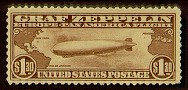
The next year the Graf Zeppelin made another famous flight, the Europa-Pan American Round Trip, commemorated in the famous U.S. airmail stamps. One of them, the $1.30 value, is shown here. They were only offered for sale of a limited time from U.S. post Offices, then withdrawn. While readily available, at a high price, they are among the most desirable items in a U.S. stamp collection.
1931/33 - Wiley Post
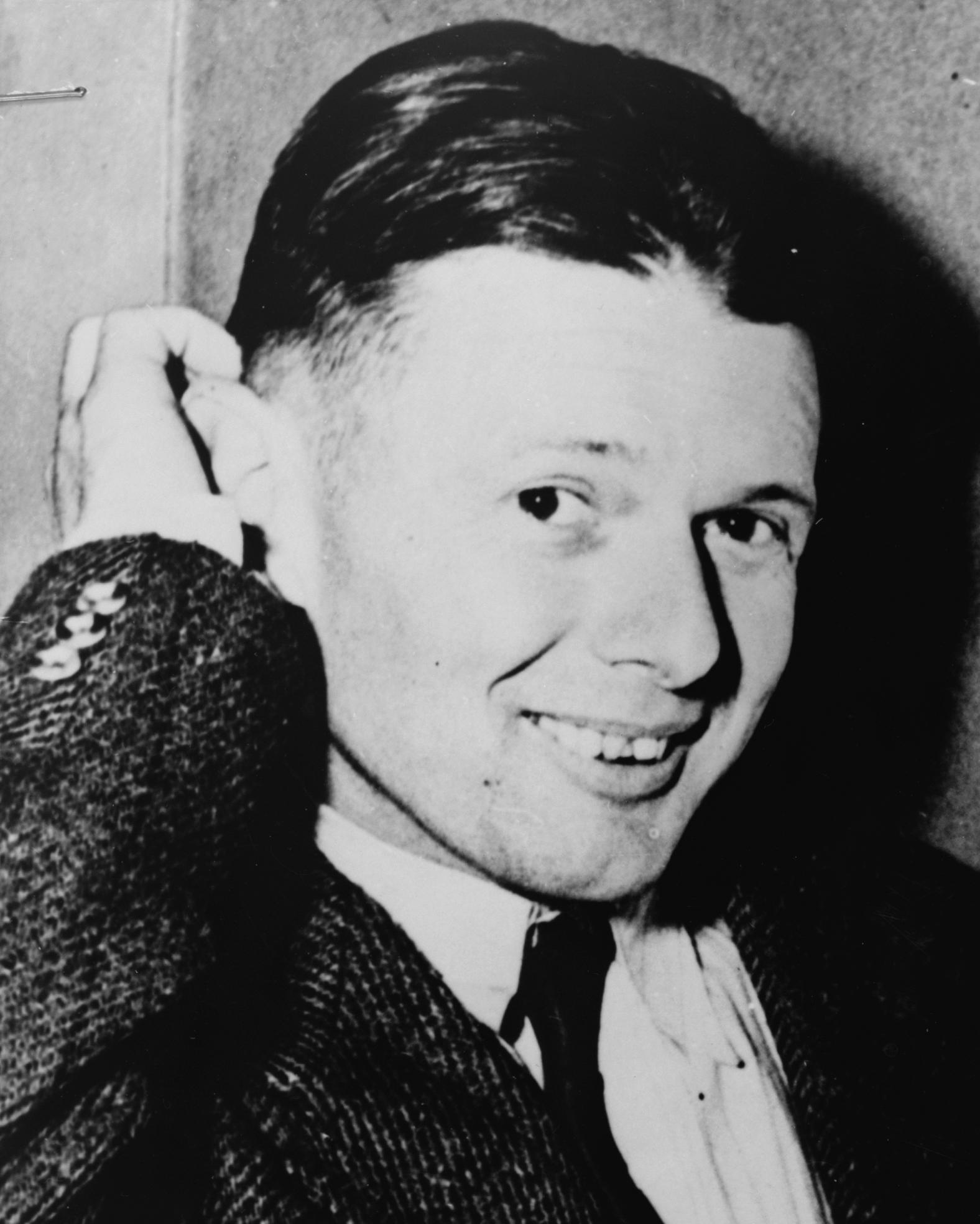
In 1931, Wiley Post and navigator Harold Gatty circled the globe in the Winnie Mae, a Lockheed Vega. Traveling over 15,000 miles, they pair didn't sleep for 8 days and 16 hours, thus smashing the Graf Zepplin's record of 21+ days.
Two years later, between July 15 - 22, 1933, Post again took the Winnie Mae around the world, this time solo, in 7 days, 19 hours, at an average traveling speed (including refueling stops) of 83 miles per hour. Read about his life and last flight here.
1938 - Howard Hughes
In 1938, Howard Hughes (the future reclusive billionaire), with four
companions, circumnavigated the globe in record time, 3 days, 19 hours,
and 8 minutes. No one had circumnavigated the globe since Wiley Post
had done so 5 years before. Full
article on Howard Hughes.
Soon the world was consumed in the monumental struggles of World War Two. Aircraft development continued, even accelerated, but all for desperately needed military advances. A new, more techical, more corporate era had begun. The Golden Age of Aviation, the era of individualists - barnstormers, Lindbergh, and endurance pilots - was over.