
World War Two Pictures
Memorable Photos of WWII
By Stephen Sherman, Dec. 2002. Updated July 8, 2013.
Here is a collection of iconic photographs of World War Two, photos that have been widely circulated. Each one is memorable, because each one captures some telling aspect of the war.
Times have changed; values have changed, but World War Two is still important, because its outcome has defined the world for more than fifty years. And each one of these photographs tells the viewer something, not just about that long-ago war, but about the world today. Is modern Israel an intransigent state? Maybe it is; now look at the boy in the Warsaw Ghetto. "Never again," the Israelis say. Is modern Germany pacifist, to a fault? Maybe it is; now look at the worn-out expression on that German soldier's face. "Never again," modern Germans say. Does the United States behave like the self-appointed world's policeman? Maybe it does. Now look at the flag-raising at Iwo Jima. "Making the world safe for democracy, anywhere and everywhere." That sense still impels American foreign policy.
Click on each image; open it up; look it over carefully; and read the caption. Every one is worth it.
|
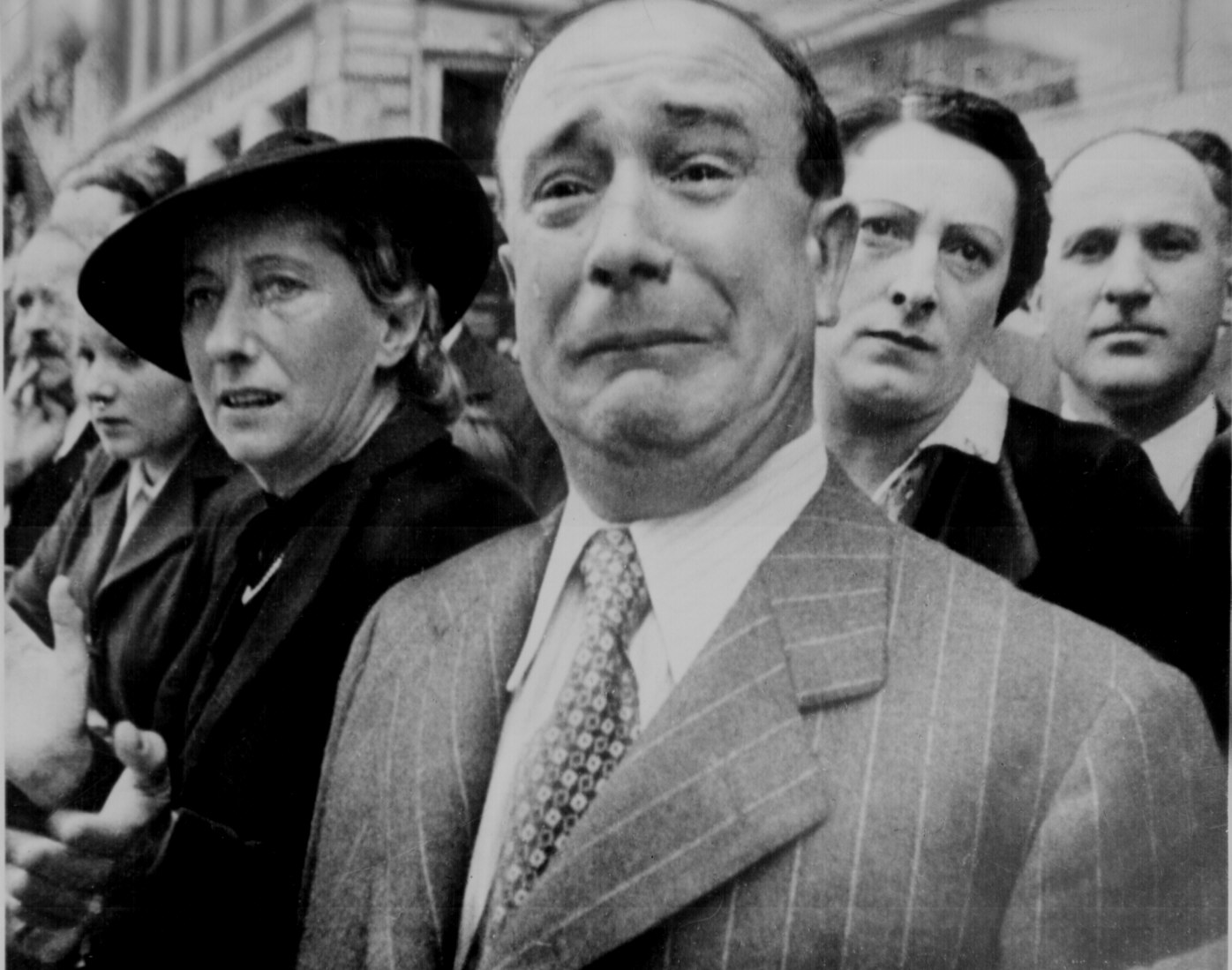
Frenchman crying - June, 1940He cries as he watches French soldiers leaving Toulon for Africa, perhaps to fight another day. The glory of France has been ground underfoot by Hitler's goose-stepping legions. In a matter of weeks, the vaunted French army, the Maginot Line, and all of France's pride has been destroyed by the Nazi blitzkreig. He is a middle-aged man, maybe in his mid Forties. Look at his tears, his tie, his nice suit. He survived World War One and looks like he has since prospered. And now? The night has fallen over France, and soon, all of Europe.He cries for the Twentieth Century. |
|
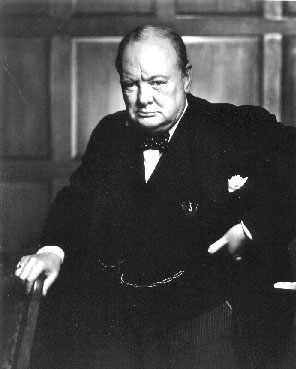
Churchill Portrait - by Yousuf Karsh, 1941Churchill's favorite portrait. He looks the wartime leader, the defiant bulldog. "We shall never surrender." I sometimes wonder if the modern enemies of English-speaking democracies and freedom understand Churchill and Roosevelt. Yousuf Karsh took the famous photograph of Winston Churchill. It was in 1941, in Ottawa, following Churchill’s speech in the House of Commons. Prime Minister King arranged for a portrait session in the Speaker’s chamber. No one had told Churchill of the session, so after lighting up a cigar he growled, “Why was I not told of this?” Karsh then asked Churchill to remove the cigar for the photographic portrait. When Churchill refused, Karsh, then 33, walked up to the great man, said, “Forgive me, sir,” and calmly snatched the cigar from Churchill’s lips. As Churchill glowered at the camera, Karsh snapped the picture. Karsh regards that portrait as one of favorites. |
|
|
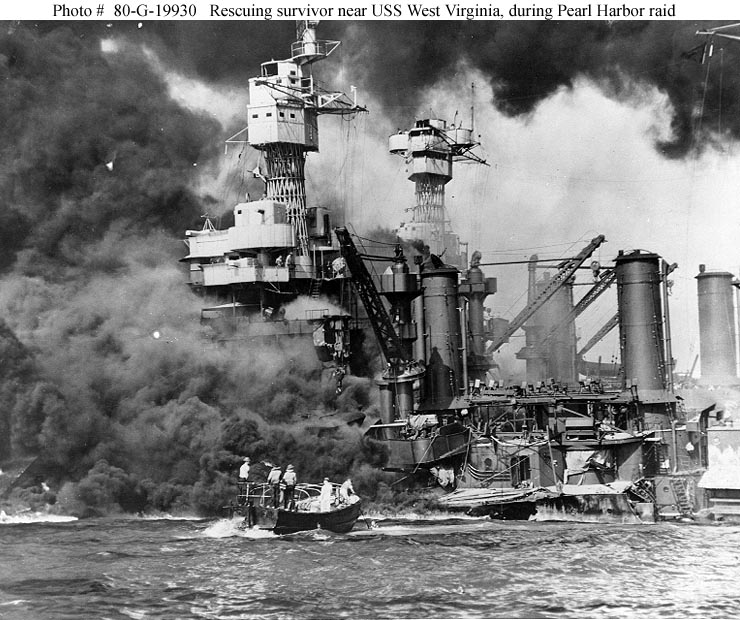
Smoking battleships at Pearl Harbor - December 7, 1941"A date which will live in infamy," Roosevelt called it. Until Septemeber 11, 2001, it was the worst attack ever on the United States. The Japanese airplanes caught the American battleships at their moorings.Sailors in a motor launch rescue a survivor from the water alongside the sunken USS West Virginia (BB-48) during or shortly after the Japanese air raid on Pearl Harbor. USS Tennessee (BB-43) is inboard of the sunken battleship. Note extensive distortion of West Virginia's lower midships superstructure, caused by torpedoes that exploded below that location. Also note 5"/25 gun, still partially covered with canvas, boat crane swung outboard and empty boat cradles near the smokestacks, and base of radar antenna atop West Virginia's foremast. |
|
|
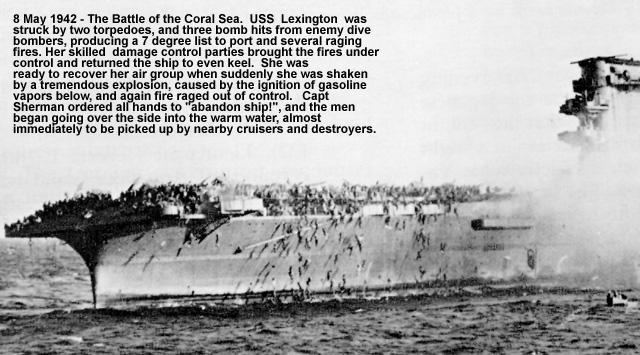
Lexington at the Coral Sea - May 7, 1942In the first naval engagement of history fought without the opposing ships making contact, U.S. carrier forces stopped a Japanese landing at Port Moresby. The Japanese lost the light carrier Shoho and the U.S. lost the carrier, USS Lexington (CV 2).Task Force 17 with the carrier USS Yorktown (CV 5), bombed Japanese transports engaged in landing troops in Tulagi Harbor, damaging several and sinking one destroyer. They then joined the other Allied naval units, including Task Force 11 with USS Lexington (CV 2). On 7 May, carrier aircraft located and sank the light carrier Shoho. The next day, the Japanese covering force was located and attacked by air, resulting in the damage of the carrier Shokaku. Simultaneously, the Japanese attacked task Force 17, scoring hits on Yorktown. Lexington was struck by a torpedo. Seconds later, a second torpedo hit directly abreast the bridge. At the same time, she took three bomb hits from dive bombers, listing to port and burning. Soon her damage control parties had brought the fires under control and returned the ship to even keel; making 25 knots, she was ready to recover her air group. Then suddenly Lexington was shaken by a tremendous explosion, caused by the ignition of gasoline vapors below, and again fire raged out of control. At 1558 Capt. Frederick C. Sherman, fearing for the safety of men working below, ordered all hands to the flight deck. At 1707, he ordered, "abandon ship!", and the men began going over the side into the warm water, almost immediately picked up by nearby cruisers and destroyers. Capt. Sherman and his executive officer, Cmdr. M. T. Seligman insured all their men were safe, then were the last to leave their ship. Lexington blazed on, flames shooting hundreds of feet into the air. The destroyer USS Phelps (DD 361) closed to 1500 yards, fired two torpedoes into the carrier's hull and, with one last heavy explosion, Lexington slid beneath the waves. |
|
|
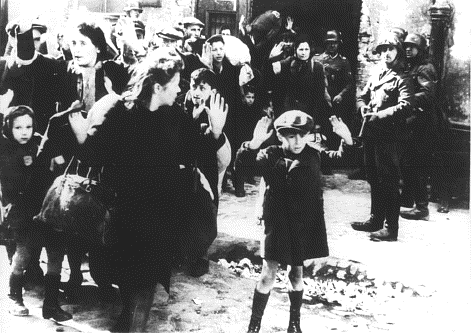
Jewish boy raising his hands, in the Warsaw Ghetto - May, 1943One of the most enduring images of the Holocaust, showing German storm troopers forcing Warsaw ghetto dwellers to move with their hands up. The Jews of the Warsaw Ghetto staged one of the few rebellions against Nazi rule in April and May, 1943. While the outcome was never in doubt, they set an example that all the world still remembers. (Except, of course, for the Iranian regime, whose only dream is to re-create the Holocaust again.)This photograph was used in the Nuremburg Trials, to help convict SS General Stroop, as evidence of the forced deportation of Jews from the Warsaw Ghetto in 1943, to extermination camps like Auschwitz. |
|
|
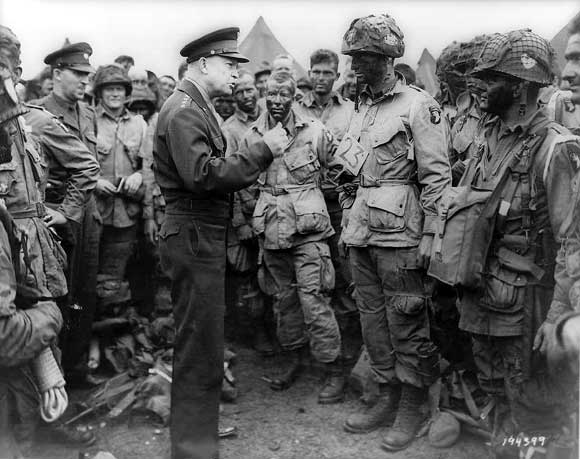
Eisenhower with airborne troops before D-Day - June 5, 1944General Dwight Eisenhower, "Ike," Supreme Commander of Allied Forces in Europe, speaks to the young soldiers of the 101st Airborne, on the eve of D-Day. Eisenhower decided to visit the division in Newbury and talk with the soldiers. Even though his group arrived unannounced and the stars on his automobile had been covered, word quickly spread of his presence. Eisenhower walked among the men asking their names and where they lived. At some point a photo was taken that captured the humanity of the general and the crushing importance of the moment."Some of the men with Gen Eisenhower are presumed to be: Pfc William Boyle, Cpl Hans Sannes, Pfc Ralph Pombano, Pfc S. W. Jackson, Sgt Delbert Williams, Cpl William E Hayes, Pfc Henry Fuller, Pfc Michael Babich. and Pfc W William Noll. All are members of Co E, 502d Parachute Infantry Regiment. The other men shown on the photo are not identified. Ike punches the air forcefully, "Full victory, or nothing else," he says. The determined troopers, faces blackened, listen attentively. The next morning, they dropped into Ste. Mere Eglise and other places to secure the beachheads at Normandy. |
|
|
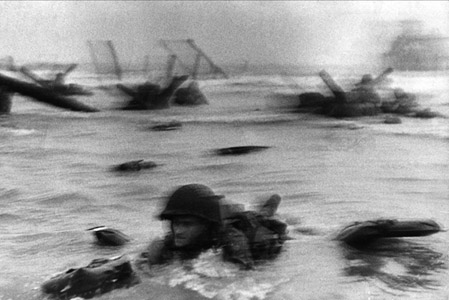
Soldier going ashore on D-Day, - by Robert Capa, June 6, 1944At 6:31 a.m. Robert Capa landed in the first wave on Omaha Beach. He captured 'bloody Omaha' in what turned out to be a world famous photo sequence.Capa described the morning, "After the pre-invasion breakfast at 3 am with hot cakes, sausages, eggs and coffee, served on the invasion ship by white-coated waiters, at 4 am the invasion barges were lowered down into the rough sea. The men from my barge waded in the water. I paused for a moment on the gangplank to take my first real picture of the invasion. The boatswain who was in a hurry to get the hell out of there, mistook my picture-taking attitude for explicable hesitation, and helped me make up my mind with a well-aimed kick in the rear. The water was cold and the beach still more than a hundred yards away. The bullets tore holes in the water around me and I made for the nearest steel obstacle." His three rolls of film were rushed to London for processing. There a darkroom technician, eager for glimpses of the landing, dried the film too fast. The excessive heat melted the emulsion and ruined all but 10 frames. The soldier in the picture has been identified as Huston Sears Riley. See more of Capa's works in Robert Capa: Photgraphs |
|
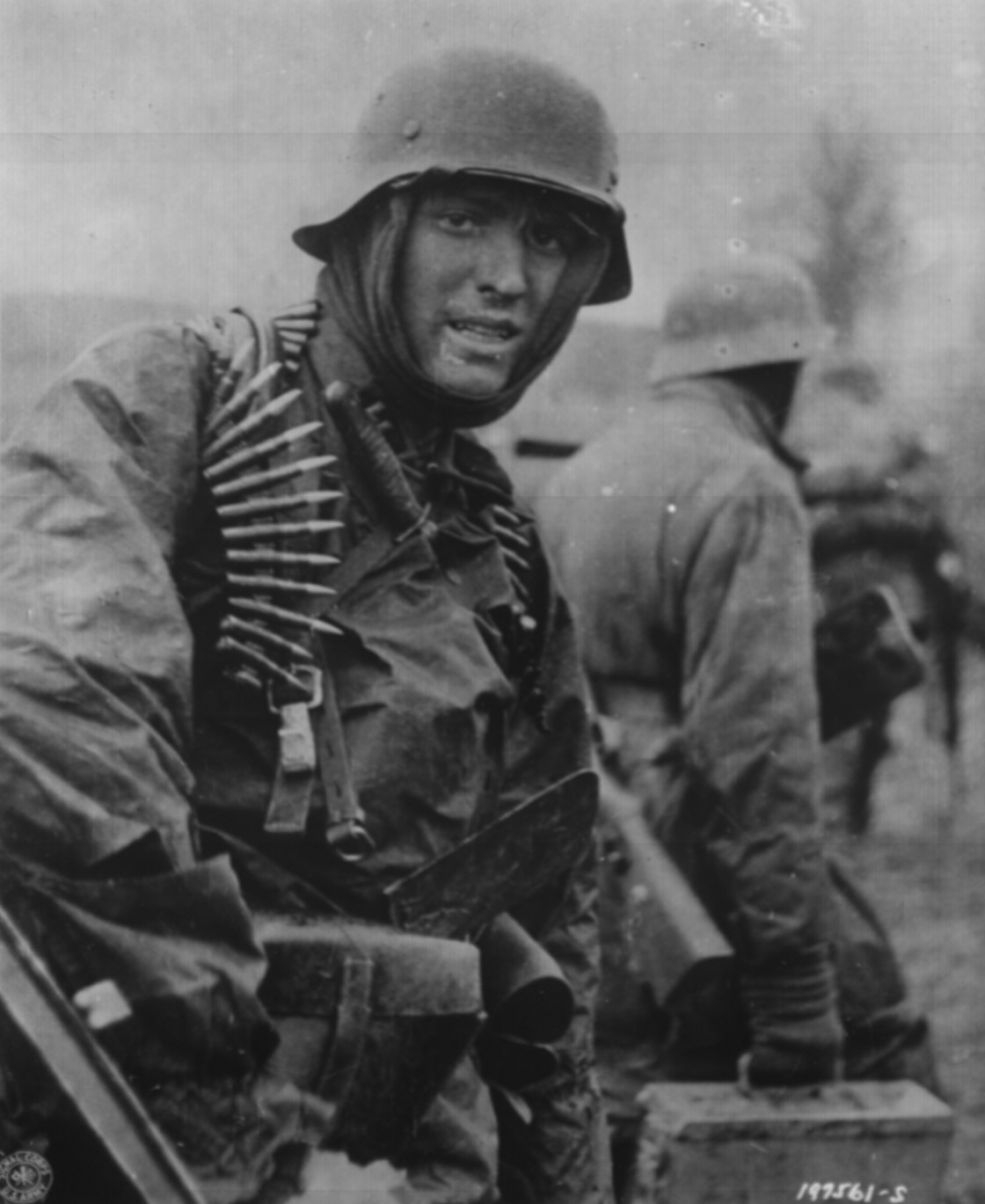
German Soldier - 1944?Serving one of the most evil regimes ever seen on Earth, the individual German soldier was renowned for his battlefield skills, dedication, and ingenuity. One can see his very human face, somewhat haggard, and his form weighted down with a belt of machine gun bullets, a bayonet, and other impedimenta of war. What a shame.The individual soldier is unknown (at least to me), taken in Belgium in the winter of 1944-45, although I originally assumed it was from the Russian Front, the classic image of the cold and worn-out German soldaten, "Winter Fritz." Read about their experiences in Frontsoldaten: The German Soldier in World War II, by Stephen G. Fritz. |
|
|
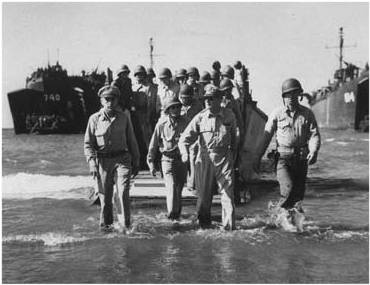
MacArthur wading ashore in the Philippines - by Carl Mydans, October 1944On October 20, 1944, a few hours after his troops landed, MacArthur waded ashore onto the Philippine island of Leyte. That day, he made a radio broadcast in which he declared, "People of the Philippines, I have returned!"Carl Mydans of Life took the dramatic photograph of General Douglas MacArthur and staff coming ashore at Lingayen Gulf, Luzon, in the Philippines on January 9, 1945. MacArthur was commander of the United States forces in the Pacific. When the United States lost the Philippines, he promised to return. Here’s Mydans’ description of that event: "Luck is forever at play in a photographer’s life. It is part of his intellectual training to know where luck is most likely to lie and to take advantage of it. In January 1945 I was the only press photographer aboard General Douglas MacArthur’s command ship as he prepared to invade Luzon, in the Philippines. I was invited to go ashore with him. As our landing craft neared the beach, I saw the Seabees had got there before us and had laid a pontoon walkway out from the beach. As we headed for it, I climbed the boat’s ramp and jumped on to the pontoons so that I could photograph MacArthur as he stepped ashore. But I suddenly heard the boat’s engines reversing and saw the boat rapidly backing away. I raced to the beach, ran some hundred yards along it and stood waiting for the boat to come to me. When it did, it dropped its ramp in knee-deep water, and I photographed MacArthur wading ashore." |
|
|
Flag Raising at Iwo Jima - by Joe Rosenthal, February 1945Surely the most famous image of the war, reproduced in many forms - a victory stamp and the U.S. Marine Corps Memorial, to name two. In one of the bloodiest campaigns of the American drive through the Central Pacific, the Marinese captured Iwo Jima on February 23, 1945. When they raised the flag on Mount Suribachi, Associated Press photographer Joe Rosenthal snapped off this shot. Unaware of its impact, he sent the negative to his wire service. The editors spotted it instantly as a moving, memorable image, of American resolve, tenacity, and victory. Within hours, it was all over the front pages of the nation's newspapers.And, no, it was not staged. The actual story has led to some confusion over the years. As soon as Mount Suribachi had been somewhat secured, some Marines raised a flag. It was a small flag, not too imposing from a distance. The commanders ordered a second, larger flag to replace it. Six Marines (Doc Bradley, Mike Strank, Rene Gagnon, Harlon Block, Ira Hayes, and Franklin Sousley) were assigned to put up the larger flag. Photographer Joe Rosenthal went along. It was still quite dangerous, as Japanese snipers lay concealed all over the island. The flag-raising party made it to the top without incident, and Rosenthal caught the famous image, quite hastily, as he had been distracted moments before the famous event. His original caption: "Atop 550-foot Suribachi Yama, the volcano at the southwest tip of Iwo Jima, Marines of the Second Battalion, 28th Regiment, Fifth Division, hoist the Stars and Stripes, signaling the capture of this key position." The son of one of the flag-raisers, James Bradley, has written an excellent book, Flags of Our Fathers, about the men involved, their service leading up to Iwo Jima, the events surrounding the flag raising and the famous photo, and the life of the men afterwards. |
|
|
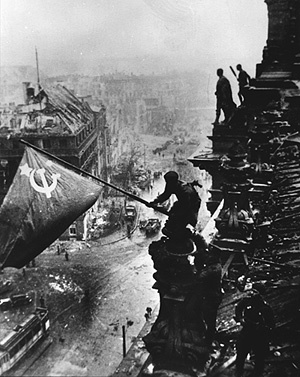
Flag Raising over the Reichstag - by cameraman Khaldei, May, 1945Stepan Andreyevich Neustroyev commanded the battalion that stormed the Reichstag in 1945 and hoisted the flag over the building. This is one of the most famous images of World War Two and only in 1997 did it become known that the photo had been doctored. Photographer Khaldei had made the flag in the photograph himself from red tablecloths from Tass, the Soviet press agency, emblazoned with the Soviet hammer and sickle. Erich Kuby's book The Russians and Berlin, page 60, says:
Evidently, the photograph of raising the Hammer and Sickle over the Reichstag was not taken at 10:30 at night. Soldiers on the street below are walking about. Most likely the famous photo was taken a day or two later. |
|
|
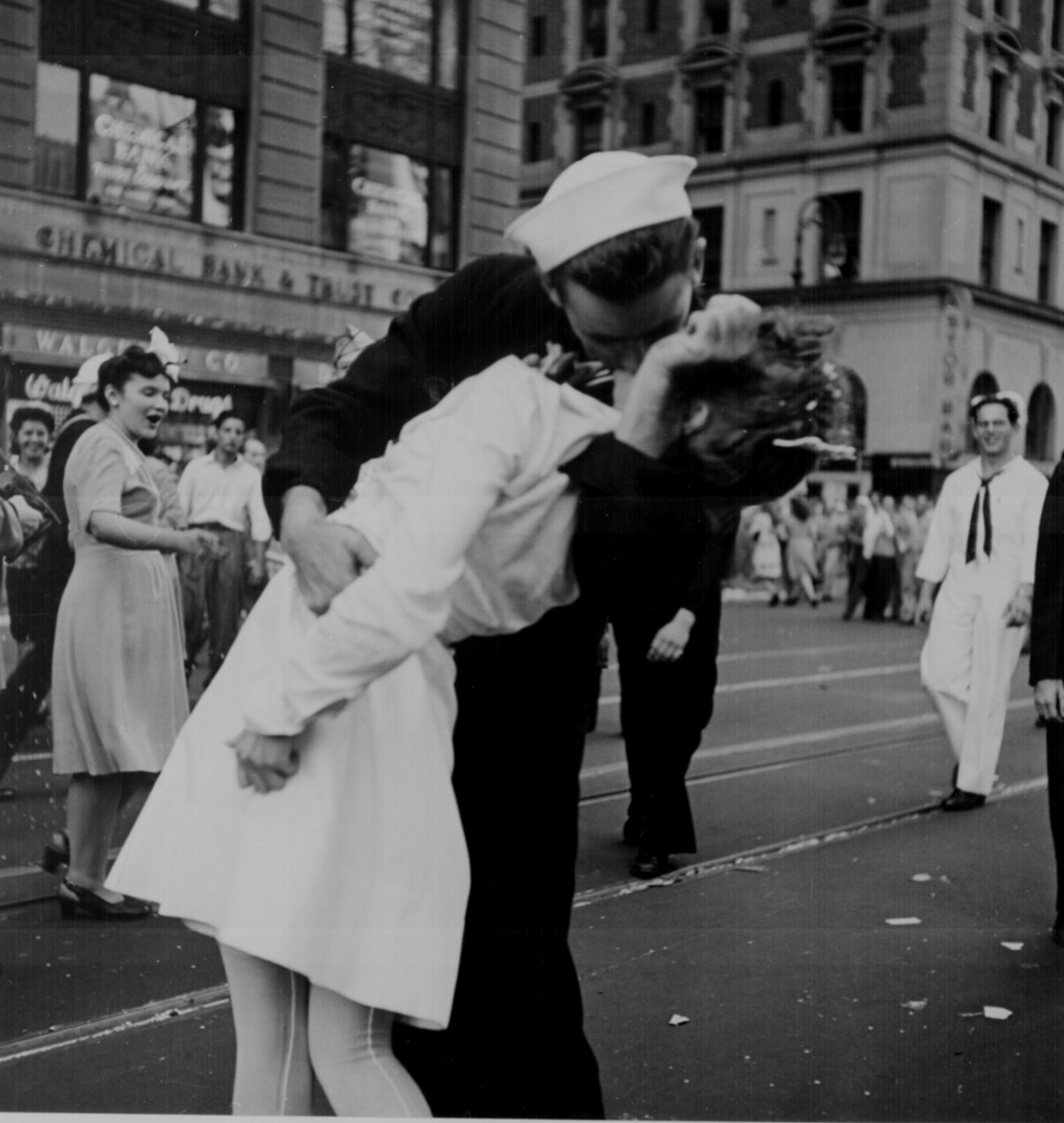
Sailor kissing girl in Times Square - by Alfred Eisenstaedt, V-J Day, 1945Alfred Eisenstaedt of LIFE took the photograph of a sailor kissing a nurse at the Times Square celebration on August 15, 1945, at the end of World War II. The photograph was one of many Eisenstaedt took that day, and he didn’t bother getting the names of anyone. Only after seeing the proofs did he realize that he had captured a decisive moment. On the 50th anniversary of the photograph, the couple was identified as Edith Shain and Carl Muscarello.Read more about his life and his images in Eisenstaedt on Eisenstaedt: A Self-Portrait. |
|
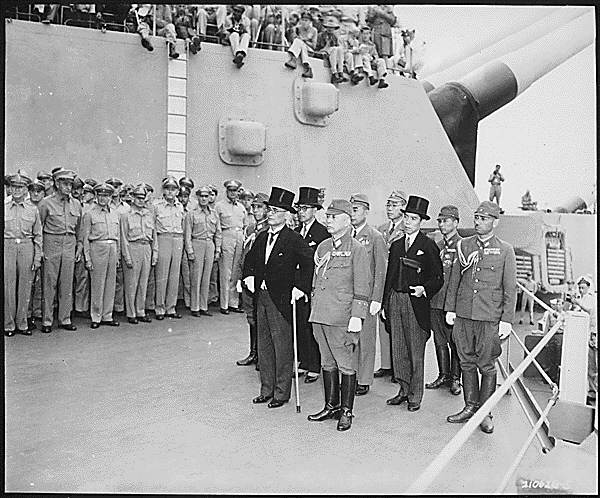
Surrender on USS Missouri - Sept. 2, 1945On September 2, 1945, the Japanese representatives signed the official Instrument of Surrender, prepared by the War Department and approved by President Truman. It set out in eight short paragraphs the complete capitulation of Japan. The opening words, "We, acting by command of and in behalf of the Emperor of Japan," signified the importance attached to the Emperor's role by the Americans who drafted the document. The short second paragraph went straight to the heart of the matter: "We hereby proclaim the unconditional surrender to the Allied Powers of the Japanese Imperial General Headquarters and of all Japanese armed forces and all armed forces under Japanese control wherever situated."Overhead, a thousand American F4U Corsairs and F6F Hellcats roared over. What had started at Pearl Harbor had been finished. |

Public Domain? Copyrights?
I understand these memorable images to be in the public domain. If I am mistaken, and a copyright holder would like better attribution, I would be pleased to do so. Or, if a copyright holder wants the images removed, of course, I would do so promptly.