
Legendary Aviators and Aircraft of World War One
By Stephen Sherman, Aug. 2001. Updated July 8, 2013.
They fought in canvas and wood biplanes that could barely fly 100 MPH. Men like von Richthofen, Rickenbacker, Bishop, Guynemer, Mannock, Ball, who flew airplanes with names like Spad, Fokker, Albatros, Nieuport, and Sopwith Camel. High above the trenches they fought heroic battles with these primitive weapons.
In this era, the top speeds were about 100 MPH. When the pilots ventured ten miles over the enemy lines, that was a notable event. The pilots carried no parachutes. The airplanes were made of wood and canvas; when they caught on fire, it spread quickly, and spelled certain death for the occupants.
The press and public, desperate for propaganda heroes amongst the
waste and
useless battles of the trenches, idolized the young heroes.
Aircraft Timeline
1914 - In the first few months of the war, combat between airplanes was unknown; they were used for reconnaissance photographs and some far-sighted aviators could envision using them for bombing. After some pilots took up pistols and rifles, some planes had machine guns mounted in the observer's seat, which typically fired rearward or to the side. When a French pilot, Roland Garros, bolted steel deflectors to his propeller, which permitted him to fire a machine gun through it, the airplane became an offensive weapon.
1915 - Then Tony Fokker, a Dutch airplane builder and entrepreneur working for the Germans, installed interrupter gear, permitting a machine gun to fire through the prop with much more reliability. For a time, the Fokkers gave the Germans an edge. Over the course of the war, the quality of Allied fighters, or "scouts," generally matched the Germans. The quality advantage swung back and forth somewhat, but even the mid-1915 "Fokker Scourge" has been overstated; the Germans just never had very many Fokker Eindeckers. And the British pusher biplanes and the French Nieuport 11 were very effective opponents.
In 1917, with the introduction of the Albatros, again the Germans had a brief qualitative edge, but the Spads, S.E.5s, and Sopwith Camels held their own. This year also saw the innovative, but short-lived triplanes.
By 1918, when Fokker introduced the D.VII and D.VIII, the overwhelming Allied numbers mooted the question of whether they were better than the best Allied scouts.
Notable Aviators |
Great Aircraft
|
|
AmericanJames Norman Hall - flier and novelistRaoul Lufbery - 17 aerial victories Frank Luke - The Balloon Buster, 18 Billy Mitchell - airpower advocate Capt. Eddie Rickenbacker - top U.S. ace, 26 The Lafayette Escadrille - Americans in French Air Service Americans with British R.F.C. - Fred Gillet - 20 victories - Wilfred Beaver - 19; Brisfit pilot - David Ingalls - 6; Naval aviator - Field Kindley - 12 - Reed Landis - 12 - Fred Libby - 14; first American ace - O.C. "Boots" LeBoutillier - 10 - Elliott Springs - 16 |
GermanOswald Boelcke - 40 victoriesHerman Göring - 22 Max Immelmann - early ace, 15 Erich Löwenhardt - 54 Lothar von Richthofen - 40 Manfred von Richthofen - The Red Baron, 80 Ernst Udet - 62 British EmpireAlbert Ball - 44Billy Barker - Canada, 50 Billy Bishop - Canada, 72 Ray Collishaw - Canada, 62 Edward "Mick" Mannock - 61 James McCudden - 57 FrenchRené Fonck - Top Allied ace, 75Roland Garros - first French ace Georges Guynemer - 53 victories Charles Nungesser - 43 OtherAnthony Fokker - Dutch aircraft designerAlexander de Seversky - Russian ace, later aircraft designer |
GermanAlbatros D.II/D.III - late 1916Fokker Dr.I Triplane - 1917, the Red Baron's famous aircraft Fokker D.VII - 1918 Fokker D.VIII - late 1918 Fokker E.III - mid 1915 BritishAVRO 504 - 1914, trainer biplaneD.H. 2 - early 1916, pusher biplane F.E. 2b - early 1916, pusher biplane S.E.5a - mid 1917, one of the best Sopwith Camel - mid 1917 Bristol F.2B Fighter "Brisfit" FrenchFrench Fighter Planes Moraine-Saulnier L - April, 1915 Nieuport 11 - early 1916 Nieuport 17 Nieuport 28 Spad S.VII Spad S.XIII - mid 1917 Voisin bomber ItalianAnsaldo S.V.A. 5 ZeppelinsObservation Balloons |
Victory Credits
The subject of aerial victories, "kills," or "official credits" has always been controversial. The confused and stressful circumstances of aerial battles have never permitted absolute certainty. (Even the use of gun cameras didn't make for certainty; in Korea, three visible tracer strikes on a MiG counted as a kill.) In the First World War, aerial combat was all new, too new for clear rules to have been established. One of the first British aces, Lanoe George Hawker, may have shot down over fifty aircraft, but in those early days, the British kept no records of aircraft destroyed.
And once they did begin, they gave credit somewhat indiscriminately; the categories of "shared," "probable," and "damaged" were not widely used until WWII. (The Aerodrome website has attempted to revise the British records using these concepts.) Of course, from the start, there was great propaganda value in shooting down the enemy's aerial weapons.
Of course, the pilots themselves usually felt that their official credits under-stated their actual kills. The leading French ace, Rene Fonck, credited with 75 kills, personally claimed 126. In other cases, official recognition was withheld from NCO's; only commissioned officers were so credited. Frederick Libby, an American who flew with the British, claimed ten as an NCO observer/gunner, but these were not officially added to the fourteen he scored as an officer and pilot. And so it goes; in all likelihood, the claims will never be resolved, especially now we are the better part of a century removed from that time.
The case of Mick Mannock is interesting. His biographer selected a number of aerial victories that put him ahead of a rival! Later research suggested that his actual total was closer to 61.
All the credits for aerial victories noted here are the "official" numbers, as reported in various secondary sources. (Even some of those vary and I usually opted for the lower figure.) Perhaps a better term than "official" would be "traditional." Whether Manfred von Richthofen shot down precisely 80 airplanes, Guynemer 53 (or 54?), Billy Bishop 73, Mick Mannock 61, and Frank Luke 21 (or 19?), perhaps does not matter too much any more. They were great fliers in an almost legendary era. Their heroism and their achievements go beyond precise enumeration of aircraft destroyed. But I have made every effort to be as accurate as possible.
Condition of Aerial Battles
On the Western Front, the British and French air force outnumbered the Germans during World War One. Together they produced 125,000 aircraft, while the Germans built less than 50,000. With these superior numbers, the Allies were generally able to take the fight to the Germans, bombing and reconnoitering over their lines.
This fundamental aspect of WWI's air combat meant that German fighter pilots usually flew over their own trenches, which required less fuel, less flying time, and also easier confirmation of downed aircraft. An added bonus for the German jagdflieger was the prevailing west wind. Any crippled German plane gliding for home had the wind at its back; while any damaged Allied plane faced head winds. Not a small consideration for the light craft of those years. Thus, while the Allies' greater numbers gave them the edge in the air war, many German aces were able to rack up impressive scores of downed British and French planes.
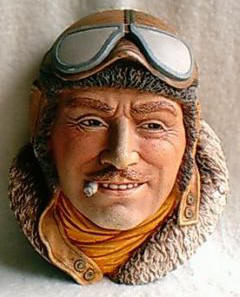
WW1 Pilot Uniforms
As shown in the picture, the stereotypical image of a WWI pilot's uniform included a leather flying helmet, goggles, a scarf, and a leather overcoat. It was cold up there, so the padded helmet and coat were needed. And as the French officer in the movie "Flyboys" pointed out, the scarf was not to make the pilot look dashing for the ladies, but to prevent chaffing on the neck as the alert pilot constantly swiveled his head. None of my dozens of pictures show any pilot in the full outfit that we expect, but if you're going to costume party as a World War One Flying Ace, this is the uniform to wear.
World War 1 Airplanes for Sale
The fact is that there are very few original WWI planes for sale. You can find reproductions, but there were (relatively speaking) few made, and being mostly made of wood and canvas, they tended to deteriorate faster than metal airplanes. Even in the 1930s, when Howard Hughes was filming "Hell's Angels," he had to scour Europe to buy enough airplanes needed for the movie. The few WW1 planes that are still around are generally in museums and places like the Old Rhinebeck Aerodrome, and they are not for sale.
World War One Airplane Games
Similarly, there is a dearth of WW1 airplane games. The market just isn't there, especially in the first-person shooter category (the most popular). Gamers want constant action, a wide variety of weapons, multiple opponents, and unpredictable complex environments. The action of a fighter pilot in his 100MPH wooden airplane, firing a single .30 caliber machine gun at a single type of opponent in an empty sky just doesn't offer enough complexity. Maybe I exaggerate, and there is a great unfilled demand for WWI fighter pilot games that just haven't been developed.
Sources:
- The Aerodrome
- Heroes of the Sunlit Sky, by Arch Whitehouse, Doubleday, 1967
- The Canvas Falcons, by Stephen Longstreet, Barnes & Noble, 1970
- Rand McNally Encyclopedia of Military Aircraft: 1914-1980, by Enzio Angelucci, The Military Press, 1983
Reading List: - Memoirs and Original Sources
- Sagittarius Rising, by Cecil Lewis, memoir of an FE2 pilot
- Fighting Fury: Five Years in the RFC, by James McCudden