
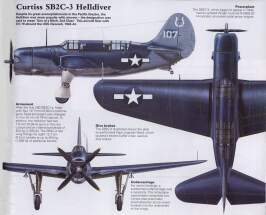
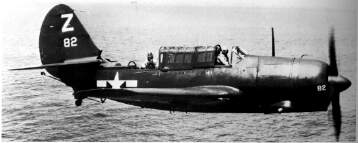
SB2C Helldiver
Curtiss dive bomber
By Stephen Sherman, Apr. 2002. Updated January 23, 2012.
Tough to fly, poorly designed, and delivered too slowly, the early models of the Curtiss SB2C would have come somewhere near the top of most lists of "Worst Aircraft of World War Two." Of course, that judgement is no reflection on the crews who had to fly "The Beast," who were as brave, skilled, and resourceful as any other pilots - perhaps more so!
But since its "teething" came under the scrutiny of wartime, some of the initial deficiencies, were compared to it predecessor, the SBD. Among these criticisms were:
- "weak structure"
- "poor handling"
- "inadequate stability"
- "unacceptable stall characteristics"
- "severe buffeting in dives"
- "sluggish ailerons"
The later models corrected these items which improved its handling, strengthened the structure, larger tail and automatic slots remedied the stall characteristics. Despite its size, the SB2C was much faster than the SBD it replaced. It could keep up with the cruise speed of the fighters. It also had substantially increased range over its predecessor. Unlike the SBD, the SB2C also had the added advantage of having folding wings and twin 20mm cannons. Although production problems persisted throughout its initial combat service, pilots soon changed their minds about the potency of the Helldiver.
The Curtiss aircraft manufacturing company produced 29, 269 aircraft during the war. They also produced 142,840 aircraft engines and 146,468 electric propellers. Among the aircraft it produced were the P-40, the C-46 and 7140 SB2C Helldivers. After WWII, the company never sought any more significant military business, and eventually became a specialty supplier to the aircraft industry.
All that being said, the Helldiver was delivered in large numbers
(7,140), equipped many US Navy squadrons, and inflicted a lot of damage
on the enemy. It was responsible for more shipping kills than any other
aircraft. After the war, it also served in the Greek and Italian Naval
Air Forces and served with the French in Viet Nam.
I have been privileged to receive an email from Bob Barnes, a Helldiver pilot in World War Two. He offers this view of the plane:
I really feel that some websites and Mr. Tillman's book were unjustly critical of the Helldiver. Apparently the early SB2C-1's, as the first built, had their problems and probably as a result I think there was a reluctance of some of the commanders to accept the Helldiver as a replacement for the reliable SBD Dauntless. The SB2C-3's that came out were much improved. From my experience it was a great dive bomber. It was faster than the SBD, easily carried 1000 lb bombs, could carry drop fuel tanks for long range missions. On one mission they needed more fighters to strafe an airfield, so they hung two pods of dual 50 cal machine guns under the wings. These were in addition to the two 20mm cannons and the 500 lb bomb already on our Helldivers. It was a very versatile aircraft.
More of Mr. Barnes' experiences flying the Helldiver follows below.
Development
Designed in response to a 1938 U.S. navy spec for a dive bomber, to replace the original SBC biplane, also known as "Helldiver," the SB2C was built around the Wright R-2600-8 engine. (In these preliminary respects, it seemed much like the ultimately much more successful Grumman Avenger torpedo bomber.) So anxious was the Navy for a modern dive bomber, that it gambled on Curtiss' reputation and placed an order for 200, even before the prototype flew on Dec. 18, 1940. The prototype crashed on Feb. 8, 1941, when its engine failed on approach. With the pressure to keep moving, Curtiss had to rebuild the plane. They lengthened the fuselage, enlarged the tail, added an autopilot, incorporated self-sealing gas tanks, added more armor, and replaced the two .30 calibers above the cowling with four wing-mounted .50 calibers. It started flying again in October. Curtiss missed its original goal, to begin delivering production aircraft in Dec. 1941. On the 21st, the prototype broke up in the air; the test pilot, B.T. Hulse, parachuted to safety.
Production
The SB2C program struggled to stay in the game. Since Curtiss' main plant in Buffalo, NY was dedicated to the P-40, the company opened a new facility in Columbus, Ohio, just for the Helldiver. Curtiss also arrange for two Canadian companies to license-build the plane. The first "production" Helldivers rolled off the line in June, 1942. The changes made from the prototype (larger tail, self-sealing tanks, more guns, etc.) increased the weight of the plane by 40%, from 7,122 lb. to 10,220.
The first Navy squadron, VS-9, to be equipped was in December, 1942.
Introduced in 1943, the SB2C-1C incorporated several changes from the original, including:
- ability to carry a torpedo
- replacement of wing guns with two 20mm cannon
- auxiliary gas tanks (45 gal.) in the wings
Variants
| Variant | Notes/Key Modifications | Dates | # Curtiss SB2C- |
# Fair- child SBF- |
# C.C.F. SBW- |
TOTAL |
|---|---|---|---|---|---|---|
| XSB2C-1 | R-2600-8 engine, 3-bladed prop, two cowling guns | first flight 12/40 | - | - | - | - |
| SB2C-1 | Larger fin & rudder, more fuel capacity, Four wing-mounted .50 cal. guns | first flight 06/42 | 200 | 50 | 66 | 316 |
| A25-A | Army version, w/o carrier gear. Incl. 410 SB2C-1A to USMC | - | 900 | - | - | 900 |
| SB2C-1C | Two 20mm cannon, first to fly in combat | Rabaul 11/43 | 778 | - | - | 778 |
| XSB2C-2 | float plane experiment | - | - | - | - | - |
| SB2C-3 | Dash-20 engine, 4-bladed prop, Incl. SB2C-3E. Max speed 293 MPH | appeared early 1944 | 1,112 | 150 | 413 | 1,675 |
| SB2C-4 | Perforated dive flaps, extra wing fittings. Incl. SB2C-4E | appeared mid 1944 | 2,045 | 100 | 270 | 2,415 |
| SB2C-5 | Slightly more fuel capacity | delivered Feb. 1945 | 970 | - | 86 | 1,056 |
| SB2C-6 | Dash-28 engine, longer fuselage | Cancelled, none built | 0 | - | - | 0 |
| SB2C TOTAL | 6,005 | 300 | 835 | 7,140 | ||
Lieutenant Commander James Vose's VB-17, operating with Bunker Hill, was the first squadron to successfully operate the SB2C Helldiver. Introduction of the new Curtiss dive bomber met a lot of resistance. On Yorktown, after numerous problems, including instances when planes broke in half - the tail grabbed by the arrester wire, while the rest of the plane smashed into the barrier. Captain "Jocko" Clark was so hardcore in his resistance that he refused to equip his bomber squadron with the SB2C, and stuck with the older SBD. He also recommended that the US Navy abandon the SB2C program altogether. But with the huge investment that had been made in the Helldiver, the Navy had little choice but to impose it on the dive bomber squadrons.
Rabaul - Nov. 1943
In the Helldiver's first combat, VB-17 launched 23 airplanes from Bunker Hill in the early morning of November 11. In command, Lt. Cdr. James "Moe" Vose, organized his dive bombers into six 4-plane divisions. He led half the group, while his Exec, Lt. Cdr. Jeff Norman, brought up the other three divisions. The equally-new F6F Hellcats "rode shotgun" as the strike airplanes flew toward the big Japanese base. The radio waves filled up with excited, but largely useless chit chat, like "Go get 'em! Look at that! Over here!" Over the harbor, Norman's division swarmed after a cruiser, while Vose's three divisions went after separate targets:
- Lt. Robert Friesz' division hit a destroyer and left it burning.
- Vose' own division scored at least three direct hits on a cruiser.
- And Lt. Robert Wood's four planes hit another cruiser. On the return flight, a zero shot up Wood's SB2C, injuring his gunner in the jaw.
On this raid, at least one rear gunner shot holes in his own aircraft's vertical tail stabilizer. (When I read this in Tillman's Helldiver book, it put to rest my wonderings about this possibility. I had imagined that perhaps aircraft with rear guns had some mechanical impediment to shooting off one's own tail. Nope. If some overly excited, 20-year old gunner kept his finger on the button and swung the gun directly back, he could do some serious damage. But, so far, I haven't read of any aircraft being lost on account of this.)
For the next four months, the Helldivers of VB-17 took part in strikes against Tarawa, Nauru, New Ireland, Truk, and the Marshalls. Lt. Cdr. Jeff Norman succeeded Vose as CO, when Vose was re-assigned stateside.
Marianas
Task Force 58 launched 240 aircraft in 12 minutes!
By this date, June 20, 1944, five VB squadrons, operating from Yorktown, Hornet, Bunker Hill, Wasp, and Essex, were equipped with Helldivers. That afternoon four of these five carriers (all but Essex,) launched 52 Curtiss dive bombers toward the 300-mile distant Japanese fleet. Forty-three of the Helldivers didn't return. While only four were lost in combat, 35 ditched for lack of fuel, and four more crashed onto US Navy ships. Most of the crewmen survived; 104 men took off in Helldivers that day; only 18 didn't make. Most of those who ditched were fished out of the water by efficient search and rescue operations.
Leyte
By October, 1944, eight large carriers were equipped with SB2C's: Hancock, Hornet, Franklin, Wasp, Intrepid, Lexington, Enterprise and Essex. The Helldivers big success in this battle was the sinking of the super-battleship Musashi. Starting with VB-18 from Intrepid, Helldivers and Avengers hammered the pride of the Japanese fleet all day. Lt. Cdr. George Ghesquiere led VB-18 in the first strike at 10:25AM. The aerial onslaught continued all day, as one Air Group after another struck. Around 7:30PM, Musashi went under.
Bob Barnes experiences during the Leyte Gulf battle:
On Oct 24 half of our Air Group was launched on a long range search for the Southern Force. The leader was the VB-20 CO CDR R. E. Riera and I flew in his division. Extra fuel tanks were hung under the wings of the Helldivers. We had 12 dive bombers, and about the same number of torpedo planes from VT-20 and fighter cover from VF-20.
We found the southern group. What a sight! 2 battleships accompanied by several cruisers and destroyers. Something you dream about as dive bomber pilot. After this information was radioed back to our carrier we started our attack. The dive bombers start from about 12000 feet and dove straight down, the torpedo planes came in lower and the fighters strafed. The anti-aircraft was terrific. Instead of the usual red, it was all colors. Apparently each ship had different colors to track their shells. We damaged both battleships with bomb hits. The VF-20 CO CDR Fred Bakutis was shot down and landed his plane in the water. One of our VB-20 planes dropped him a larger raft. He drifted for 7 days before being picked up by a US submarine. The fleet battles were so intense there was no time to try to rescue him.
In the afternoon our second wave of planes from VB-20 was launched against the middle Japanese Task Group consisting of the super battleship Musashi. Many air groups pounded this naval force all day and the Musashi was eventually sunk.
The next morning Oct 25, l944 we were launched before daylight with 12 VB-20 Helldivers with CDR Riera leading the group of VF and VT aircraft. I was again in the CO's Division of the first 6 aircraft. Once airborne we learned of our destination, the Northern Japanese Task Group. We heard a search plane over this Japanese Force describe 4 carriers with cruiser and destroyer escorts, heard the words "Carriers are turning into the wind to their launch aircraft." This was going to be even bigger than the day before. As it became light and we approached the Japanese, what a sight. It looked like the whole Japanese Navy and this was our target. As Air Groups from other US Carriers were arriving also, the target coordinator assigned VB-20, VT-20 and VF-20 one of the Japanese carriers, the Zuikaku, to attack. Once again our Helldivers peeled off one at a time from 12000 feet and dived straight down on the Zuikaku. Numerous bomb hits were scored.
The AA was the most intense I have ever seen with all ships firing everything they had at our aircraft. After releasing our bomb we pulled out as low as we could near the water to avoid the AA. This meant flying out of the middle of the enemy ships, while every ship you flew by was shooting at you. Believe me the sky was solid red with AA. Continued attacks by other Air Groups during the day eventually finished the Japanese carriers. After our attack we rendevoused outside the Japanese Task Force and headed for the Enterprise. I got a direct bomb hit on the battleship the first day Oct 24 and a bomb hit on the Japanese carrier on the mission Oct 25. Our squadron had many rough days but those two days were without a doubt the worst days of combat.
Aerial Victories
Helldivers claimed 44 air-to-air kills, the leading SB2C pilot in this regard was Lt. Robert "Zekie" Parker, later killed by a kamikaze attack. Seventeen SB2C's were downed by enemy fighters.
The End - 1945
Late in the war, Helldivers flew many missions against Japanese bases on Formosa. Again, Bob Barnes describes one:
We headed for Formosa (Taiwan) to attack a very large Japanese airfield. We headed in with VB-20 leading the way under CDR Riera and VT-20 and VF-20 for fighter cover. As we got close to the target and ready to peel off for our dive we heard the fighters on the radio say 7 Zekes were heading to attack. I switched gas tanks to have a full tank and peeled off. On the way down (straight down) I was concentrating on the target, wind etc. when I heard a tremendous explosion. The plane shook and at first I thought I had forgotten to switch tanks and the empty tank had caused the engine to backfire.Here I was, in a dive, through heavy anti-aircraft fire and Jap fighters chasing me. I switched tanks again. I released the bomb, pulled out and the engine quit. In the meantime my rear seat aircrewman confirmed we had been hit in the tail by AA. I quickly checked my fuel tanks and then realized I had already switched tanks and in the heat of the moment switched back to the low tank. Switching back to the full tank the engine started. What a relief! I headed for our rendevous for the return to the Enterprise. After landing the plane had a large hole in the vertical stabilizer from the AA that had also exploded and sprayed shrapnel holes all over the rear of the Helldiver.
Post War
Some Helldivers served with the French Aeronavale in the Indochina War in the early 1950's, as well as with Portugal, Greece, Italy, and Thailand.
Survivors/Museums
One still airworthy, according to Warbird Alley. This is number 32, operated by the Commemorative Air Force. A distinctly non-flying Helldiver is on display at New York City's Intrepid Sea-Air-Space Museum.
Links:
Aviation History article on the Helldiver