

Fighting Squadrons of the USMC in WWII
By Stephen Sherman, June, 1999. Updated July 1, 2011.
In World War Two, the United States Marine Corps organized 61 fighting and night-fighting squadrons. Twenty of those those squadrons counted at least one ace on its pilot roster. Those 20 squadrons are profiled here.
What does VMF mean?
Marine squadrons were designated by letters and numbers that identified the squadron's role and organization, in a pre-war numbering scheme shared with the U.S. Navy.
The first letter "V" stood for
"Heavier-than-air,", as opposed to "Z" stood for Lighter-than-air, i.e.
dirigibles, which figured into the scheme when it was designed in the
inter-war period. The second letter "M" meant Marine Corps. No
2nd letter, by omission, meant Navy; thus VF-17 was a Navy Fighting
Squadron. The third (and possible fourth) letters indicated the purpose
of the squadron.
"F" = Fighting
"SB" = Scout Bombing
"TB" = Torpedo Bombing
"O" = Observation
"J" = Transport & Photographic
Thus, Marine Fighting Squadrons were identified by "VMF," and night fighting squadrons by "VMF(N)."
Typical Squadron History
Like the Navy, the Marine Corps constantly shuffled men and reorganized squadrons. But there was a general pattern. A squadron would be organized at a stateside Marine Air Base - maybe Ewa, Cherry Point, or El Centro. After spending a few months there learning its equipment and assignment, it would go overseas for its first six-week combat tour. Following a short period of R&R, the squadron (less any casualties or men transferred out) would return to a rear area base, say Efate or Espiritu Santo to integrate the new men and perhaps learn new techniques or equipment. Then it would embark on a second six-week combat tour. After another R&R, replacements would come in, and the squadron would fly a third combat tour. But any one pilot was only obligated to fly two combat tours; fliers on the sick or injured list during the first or second tours would fly the third tour.
At the completion of the third combat tour, i.e after about 8 months of front line service, the squadron would be broken up. The combat veterans would return to the Z.I. (Zone of the Interior, i.e. the United States) for training, staff, or test duty. The free squadron number would be recycled. A new group of men would comprise the new squadron, and they would repeat the process.
As sketched out here, this was general pattern; the demands of the war frequently interrupted or altered this.
The following information was summarized from Robert Sherrod's excellent History of Marine Corps Aviation in World War II. Any errors or over-simplifications are my mistakes, not the author's.
| Short Summaries of all 20 Squadrons on this page | Longer Articles on a Few Squadrons Click on the links to go there. |
|
|---|---|---|
|
VMF-112 - "Wolf Pack" VMF-121 - Cactus, 208 aerial victories VMF-122 - Cactus VMF-124 - first Corsair Squadron VMF-212 - Cactus VMF-214 - "Black Sheep" |
VMF-223 - Cactus VMF-224 - Cactus VMF-323 - "Death Rattlers" |
VMF-214 - "Black Sheep" VMF-323 - "Death Rattlers" VMF(N)-533 |
Cactus Squadrons: Guadalcanal, Aug. 1942 - Feb. 1943
VMF-223
The first fighter squadron in the Solomons, arriving on August 20, 1942. After heroic service with the Cactus Air Force, the squadron left for home on Oct. 16. In 1944, VMF-223 participated in the aerial siege of Rabaul; in Jan. 1945 it participated in the liberation of the Philippines.
VMF-223 was credited with downing 132 Japanese planes.
|
|
VMF-224
The other early-arriving fighter squadron of the Cactus Air Force, landing at Henderson Field Aug. 30, 1942. It had been organized on May 1, in the post-Pearl Harbor expansion of Marine air. 224 fought at Guadalcanal for two months, rotating home on Nov. 1. After some time stateside, VMF-224 returned to the Pacific, attacking the by-passed Japanese held Marshalls in 1944.
VMF-224 claimed the aerial destruction of 115 enemy aircraft.
|
|
VMF-212
Operated out of Guadalcanal Sep. - Nov. 1942. Eight of its pilots flew on Temporary Attached Duty with VMF-223, starting on Aug.30. The squadron was commissioned Mar. 1, 1942 at Ewa, and moved up to Efate (the front line at the time) in four weeks. After completing its stint at Guadalcanal in Nov. 1942, VMF-212 returned to the West Coast. By August, 1943, it was back in the Solomons, now flying Corsairs. They covered the landings on Bougainville, and a month later its ground crew was operating out of Torokina.
It remained in the Solomons through the end of 1944.
VMF-212 claimed the aerial destruction of 132 Japanese planes.
|
|
VMF-121
Commissioned at Quantico in mid-1941. Four days after Pearl Harbor, the squadron headed for the West Coast.
The forward flight echelon touched down at Guadalcanal in late September; all pilots arrived by Oct. 9, 1942. VMF-121 scored 160+ victories in Wildcats (the most of any USMC or Navy squadron) before transitioning to F4U Corsairs in June, 1943. After serving three combat tours in the Solomons, the squadron was re-organized. The new VMF-121 served at Peleliu from Sept. 1944 until the end of the war, including strikes against Yap.
VMF-121 was credited with downing 208 Japanese planes.
|
|
VMF-112
First echelon landed at Henderson Field Nov. 3, 1942.
VMF-112 was credited with downing 140 enemy aircraft. Transitioned to Corsairs by May 19.
|
|
VMF-122
Some pilots landed at Henderson Field Nov. 13, 1942, for duty with VMF-121. The squadron operated in the Solomons from Nov. 1942 to July, 1943; it switched over to Corsairs by mid-June. After re-organizing at El Centro, it returned to Emirau and flew strikes against the Palaus in late 1944.
VMF-122 claimed 35 Japanese airplanes.
|
|
Solomons Squadrons: Feb. 1943 - Jan. 1944
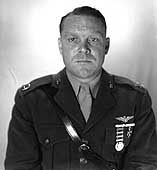
VMF-221
The original VMF-221, under the command of Major Floyd Parks, was wiped out at Midway. The re-organized squadron arrived at Guadalcanal in Feb. 1943. It earned a Presidential Unit Citation for its heroic sacrifice at Midway. Transitioned to Corsairs by May 19, 1943.
VMF-221 claimed the aerial destruction of 185 enemy aircraft, the second highest-scoring VMF.
 |
|
VMF-124
First Corsair-equipped squadron, arrived Guadalcanal on Feb. 12, 1943, and escorted a rescue mission before lunch. Remained in the Solomons until Sept. 1943. Reorganized and trained at Mojave until Sept. 1944. In Jan. 1945 supported Philippine landings and struck Japan and Okinawa in early 1945.
VMF-124 was credited with downing 78 Japanese airplanes.
|
|
VMF-213
Squadron left for Espiritu in Feb. 1943 and promptly transitioned to F4U Corsairs. It moved up to Guadalcanal in April. Its CO, Major Britt, was killed in a take-off accident that month. In June, it relieved VMF-124 in the Russells. Continued flying in the Solomons until Dec. 43. Re-formed at Mojave and trained at Ewa in 1944. In Jan. 1945 supported Philippine landings and struck Japan and Okinawa in early 1945.
VMF-213 was credited with downing 117 enemy aircraft.
|
|
VMF-214
Longer VMF-214 Squadron History
Original "Swashbucklers" squadron, flying F4F Wildcats, operated from Guadalcanal from March to May, 1943. It was one of the last VMF's to changeover from Wildcats to Corsairs, doing so by June 19, 1943. Boyington's famous "Black Sheep" squadron began combat in Sept. 1943. It earned a Presidential Unit Citation for its actions in the Solomons. After reorganization, VMF-214 served on Franklin when it was hit by a kamikaze in March, 1945.
VMF-214 claimed the aerial destruction of 127 Japanese planes.
|
|
VMF-215
Originally a Scout Bombing squadron, it was redesignated at a fighter squadron in Sept. 1942. Passed thru Hawaii and Midway in early 1943, on its way to the Solomons. While still based at Espiritu, began combat missions over the Solomons in late July, 1943. Moved its base progressively forward: to Munda, Vella Lavella, then Torokina. Reorganized in March, 1944 and returned to Bougainville. After Oct. 1944, served stateside as a replacement training squadron.VMF-215 was credited with downing 137 enemy aircraft.
|
|
VMF-222
Commissioned in March, 1942 at Midway. Flight echelon to Guadalcanal on Sept. 3, 1943. Participated in Solomons campaign and reduction of Rabaul until Jan. 1945. To Okinawa in May 1945.
VMF-222 shot down 53 Japanese planes.
|
|
VMF-211
One of the oldest Marine Fighting Squadrons, redesignated from VMF-2 in July, 1941, the flight echelon of the squadron was wiped out at Wake Island in December, 1941. Immediately re-built, the squadron went to Palmyra for base defense duty. In Oct. 1943, flight echelon moved to Russells. From late 1943 through 1944, it was based in the Solomons.
VMF-211 claimed the aerial destruction of 91 enemy aircraft.
|
|
VMF-321
Flight echelon to Barakoma (New Georgia group) Dec. 24, 1943.
VMF-321 was credited with downing 39 Japanese planes.
|
|
Okinawa Squadrons: 1944 - Aug. 1945
VMF-323
Longer VMF-323 Squadron History
Commissioned in Aug. 1943. Forward echelon at Okinawa on Apr. 2, 1945
VMF-323 was credited with downing 124 Japanese planes, tops among Marine squadrons operating in 1945.
|
|
VMF-441
Organized Oct. 1942 at Samoa. To the Marshalls in Feb. 1944. After flying suppression missions against by-passed Wotje and Maloelap in mid-1944, to Okinawa's Yontan airfield Apr. 7, 1945VMF-441 was credited with downing 49 enemy aircraft, mostly kamikazes.
|
|
VMF(N)-542
A night fighting squadron commissioned in March, 1944 at Cherry Point. Trained till the end of 1944, when it shipped out for the Pacific. Landed April 8, 1945 at Okinawa.VMF(N)-542 claimed the aerial destruction of 18 Japanese planes.
|
|
VMF-311
Arrived Kwajalein, Marshalls in Feb. 1944. To Okinawa's Yontan airfield Apr. 7, 1945VMF-311 was credited with downing 71 enemy aircraft.
|
|
VMF-312
To Okinawa's Yontan airfield Apr. 6, 1945VMF-312 was credited with downing 59 Japanese planes, mostly kamikazes.
|
|
VMF(N)-533
Flew to Yontan airfield, Okinawa on May 14, 1945.VMF(N)-533 claimed the aerial destruction of 35 enemy aircraft, the most for any Marine nightfighting squadron.
|
|
 Fire in the Sky: The Air War in the South Pacific,
by Eric M. Bergerud
Fire in the Sky: The Air War in the South Pacific,
by Eric M. Bergerud
A readable, but detailed summary of the topic (750 pages
worth). The author covers much of the logistical background to the war.
It's an excellent complement to the information presented on this web
site, because it omits all the "...and then he chandelled sharply up to
left, caught the enemy in his sights and squeezed the trigger" stuff. Buy 'Fire in the Sky: The Air War in the South Pacific' at Amazon.com |
 |