
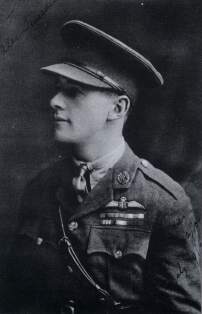
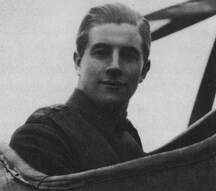
Major James McCudden
Flying Fury: Five Years in the Royal Flying Corps
By Stephen Sherman, Aug. 2002. Updated April 11, 2012.
McCudden's memoirs, Flying Fury: Five Years in the Royal Flying Corps, written a few months before his death at age 23 in 1918, do not grab the reader's attention with thrilling tales of dogfights, bravery, and aerial combat. Rather, the book paints a realistic picture of life for a British scout pilot in the First World War. The reader gets a sense of how incredibly primitive aerial warfare was in those years. In almost every fight, McCudden struggles with his balky machine guns, almost more than with the "Huns," as he invariably refers to the Germans.
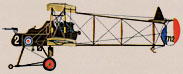
He spent the first half of his career in pusher biplanes, D.H.2's and F.E.2b's. The constant influence of the wind and the cold pervade the book. Above all, the extremely limited range of fighter combat, with constant reference to which side of the lines things happened.
Another aspect of Flying Fury that I enjoyed is McCudden's use of aviation jargon. Anti-aircraft fire is "Archie" or "Archies." On one page, he mentions an "Immelmann Turn," with that exact phrase. Later, he describes planes flying in a defensive circle, without calling it a "Lufbery." Also, I don't recall him using the word "ace" to describe a scout pilot with 5, or 10, victories to his credit.
Enlisted Mechanic
He started with the British Army at age 13, as a bugler. After five years, he joined the Royal Flying Corps (RFC) in 1913, as a mechanic servicing airplanes, as an engine-fitter. One of his first "accomplishments" was to swing the propeller of a Caudron, inadvertently starting its engine, and watching it chew up a nearby Maurice Farman machine, for which he spent some time in the guard room. In April, 1914 he was promoted to Aviation Mechanic First Class. In the pre-war RFC, he encountered a bewildering (at least to the modern reader) variety of aircraft: the B.E.2a, a 50 Gnome hp Avro, a 50 hp Bleriot, an Henri Farman, the B.E.4a "Bloater," and 80 hp Bleriots.
He arrived in France in August, soon caught up in one retreat after another, as the British fell back, until the trench lines stabilized. While his book focuses on the flying activities of his No. 3 Squadron, McCudden himself was grinding inlet valves and replacing engines; he was promoted to Corporal in November, 1914.
Observer
In the first half of 1915, he began to go aloft as a gunner/observer in two seater Morane Parasols. Promoted to Sergeant in April, 1915, he was then "in charge of all the engines in my flight." In the latter part of 1915, he describes how "aerial fights began to get more numerous," as the two sides began firing at each other's reconnaissance machines. Max Immelmann scourged the British fliers.
In January 1916, he continued as an observer, getting shot at by "Archie" and by Hun Fokkers. It's clear that his flights all occurred within a few miles of the lines.
Pilot
For the first two years, McCudden flew in pusher biplanes, the mainstay of the RFC scouts, airplanes like the F.E. 2b and the D.H.2. They seem awkward and just "totally wrong" to the modern eye, accustomed as we are to "tractor" propeller-driven aircraft.
In late January, 1916 he was selected for flight training back in England and promoted to Flight Sergeant. He spent several months in England, first learning to fly and then teaching others. He returned to France, posted to No. 20 Squadron in July, "to fly F.E.'s with Rolls-Royce engines. ... In those days this F.E. with the 250 Rolls-Royce was a very good and powerful machine, and the enemy very much respected it.
First Kill
In August, 1916, he posted to No. 29 Squadron, to fly D.H.2's, "a cold little machine," but lighter and more maneuverable than the two-place F.E. On September 6, he was patrol over Ypres, when he spotted a two-seater and gave chase. At 400 yard, he emptied a Lewis drum, without apparent effect. He changed drums and fired it off. The German gunner never replied, but the plane kept heading down. At 4,000 feet, a third drum. At 2,000 feet, now well east of the Germa lines, he gave up as the Hun dived steeply through some clouds over Gheluve. "Three days later a report came from an agent to say "that a German machine had crashed on the Menin Road at Gheluve, and that the time and place coincided with my combat report - so that was my first Hun."
A Good Scout Pilot

In January, 1917 he was commissioned as an officer. McCudden was no braggart, and the low-key, English gentleman's writing style of Flying Fury make it easy to overlook the fact that this book was written by a 23 year-old who had shot down 56 of his opponents and survived five years, in an environment where survival was measured in weeks or months. He must have been doing something right!
First, his background as a mechanic helped him maintain his personal aircraft in top condition. He writes about spending days getting his guns working properly and about the "special gadgets" he had installed on his machine. Detailed, knowledgeable attention to all the elements of flying & fighting served him well. He commented that it was easier to approach a Hun from a good position than to do the actual shooting. "It may sound absurd," he wrote,"but such a thing as having dirty goggles makes all the difference between getting or not getting a Hun."
Second, he was a keen observer of the enemy psychology, lessons which he absorbed first as a ground mechanic, then as an oberver, even before he became a pilot. One time he related that it was time well-spent to go up, and just observe the enemy actions.
"The weather still continued very clear, cold and frosty, and every day I was up, waiting about over our lines for Hun two-seaters to come across after I had done my daily patrol. If patience and perseverance would meet their just reward I certainly should have got many more Huns than I did, for I was up at every opportunity studying the two-seater's habits, his characteristics, and his different types of machines and methods of working. In fact, this branch pf work alone, just studying the habits, work and psychology of the enemy aeroplane crews, constitutes a complete education of great interest."
Related to the psychological aspect, McCudden believed in fighting to win, when the odds favored him. Some aggressive pilots wanted to attack the Huns whenever possible, regardless of conditions. Not McCudden. He sought combat when he had an advantage, and when the Germans had the advantage, he broke off and headed for home.
Third (and one cannot find this in the book), McCudden must have been possessed of the physical attributes of a fighter pilot - good eyesight, quick reflexes, the strength and instinct to handle an airplane, the marksmanship to hit a moving target from a moving platform, etc.
After spending much of the Spring of 1917 back in England, he returned again to the Front with No. 66 Sqn., flying a Sopwith Pup. Up to this time, he had shot down five planes.
No. 56 Squadron and the S.E.5a
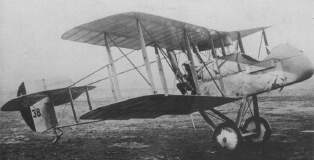
In the summer, he was invited to go on patrol with the prestigious No. 56 Squadron, the best British scout unit inthe Great War. On July 21, his first day at the controls of the 200 hp S.E.5a, he downed an Albatros DV over Polygon Wood. He was shortly assigned to No. 56 Squadron, as a Flight Commander. He had arrived!
The Death of Werner Voss
McCudden participated in one of the great aerial battles of all-time. I suppose that if we sang songs and wrote Iliads about our war heroes any more, that day of September 23rd, 1917 would be so celebrated.
We were just on the point of engaging six Albatros Scouts away to our right, when we saw ahead of us, just above Poelcappelle, an S.E. half spinning down closely pursued by a silvery blue German triplane at very close range. The S.E. certainly looked very unhappy, so we changed our minds about attacking the six V-strutters, and went to the rescue of the unfortunate S.E.
The Hun triplane was practically underneath our formation now, and so down we dived at a colossal speed. I went to the right, Rhys-Davids to the left, and we got behind the triplane together. The German pilot saw us and turned in a most disconcertingly quick manner, not a climbing nor Immelmann turn, but a sort of flat half spin. By now the German triplane was in the middle of our formation, and its handling was wonderful to behold. The pilot seemed to be firing at all of us simultaneously, and although I got behind him a second time, I could hardly stay there for a second. His movements were so quick and uncertain that none of us could hold him in sight at all for any decisive time.
I now got a good opportunity as he was coming towards me nose on, and slightly underneath, and had apparently not seen me. I dropped my nose, got him well in my sight, and pressed both triggers. As soon as I fired up came his nose at me, and I heard clack-clack-clack-clack, as his bullets passed close to me and through my wings. I distinctly noticed the red-yellow flashes from his parallel Spandau guns. As he flashed by me I caught a glimpse of a black head in the triplane with no hat on at all.
By this time a red-nosed Albatros Scout had arrived, and was apparently doing its best to guard the triplane's tail, and it was well handled too. The formation of six Albatros Scouts which we were going to attack at first stayed above us, and were prevented from diving on us by the arrival of a formation of Spads, whose leader apparently appreciated our position, and kept the six Albatroses otherwise engaged.
The triplane was still circling round in the midst of six S.E.'s, who were all firing at it as opportunity offered, and at one time I noted the triplane in the apex of a cone of tracer bullets from at least five machines simultaneously, and each machine had two guns. By now the fighting was very low and the red-nosed Albatros had gone down and out, but the triplane still remained. I had temporarily lost sight of the triplane whilst changing a drum of my Lewis gun, and when I next saw him he was very low, still being engaged by an S.E. marked I, the pilot being Rhys-Davids. I noticed that the triplane's movements were very erratic, and then I saw him go into a fairly steep dive and so I continued to watch, and then saw the triplane hit the ground and disappear into a thousand fragments, for it seemed to me that it literally went to powder.
Strange to say, I was the only pilot who witnessed the triplane crash, for even Rhys-Davids, who finally shot it down, did not see its end.
It was now quite late, so we flew home to the aerodrome, and as long as I live I shall never forget my admiration for that German pilot, who single-handed fought seven of us for ten minutes, and also put some bullets through all of our machines. His flying was wonderful, his courage magnificent, and in my opinion he is the bravest German airman whom it has been my privilege to see fight.
We arrived back at the mess, and at dinner the main topic was the wonderful fight. We all conjectured that the enemy pilot must be one of the enemy's best, and we debated as to whether it was Richthofen or Wolff or Voss. The triplane fell in our lines, and the next morning we had a wire from the Wing saying that the dead pilot was found wearing the Boeleke collar and his name was Werner Voss. He had the "Ordre Pour le Merite."
Rhys-Davids came in for a shower of congratulations, and no one deserved them better, but as the boy himself said to me, "Oh, if I could only have brought him down alive," and his remark was in agreement with my own thoughts."
- - - - (from Flying Fury: Five Years in the Royal Flying Corps)
A "Perfectly Good Hun"
Pilots took quite a proprietary interest in aircraft that they had downed on their side of the side of the lines, at least. On one occasion, he forced down an undamaged L.V.G. two-seater, and commented "to bring a Hun down in our lines was an exception." On landing he hustled over to the downed plane, noting its excellent condition as well as the condition of the two occupants (the pilot soon died of his wounds). McCudden then related his umbrage that some British soldiers burnt "my perfectly good Hun" in anticipation of being forced to retreat. He ruefully noted that the trench lines didn't move much, and the burnt wreck of the L.V.G. lay there inside the British lines for some time.
Another time, he tramped several miles through the cold and the wet and the mud, in an effort to get to one of his victims, but as he approached the area, the German shellfire was too intense, and he was forced to return without having gotten near his trophy. This brief exposure to the mess and muck of the infantry was quite enough for him.
Top Ace
Throughout the end of 1917 and early 1918, McCudden went on a tear, downing 5 planes in September, 3 in October, 5 in November, 14 in December, 9 in January, and 11 in February. He finished with 57 officially credited aerial victories, and was awarded the Victoria Cross.
After five years at the Front, in the most dangerous kind of flying, he died when his engine malfunctioned during an ordinary flight between bases, July 9, 1918.