
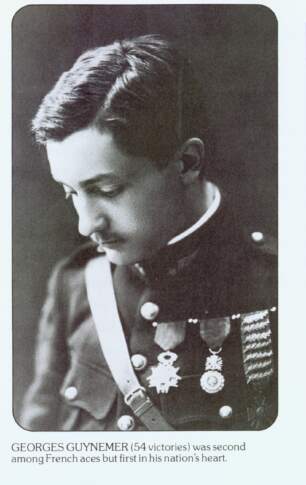
Georges Guynemer
Beloved French Ace, 53 victories
By Stephen Sherman, Aug. 2001. Updated April 15, 2012.
"Dead on the field of honor, September 11, 1917. A legendary hero fallen in glory from the sky after three years of hard and incessant struggle, he will remain the purest symbol of national ideals for his indomitable tenacity of purpose, his ferocious verve and sublime gallantry. Animated by an invincible faith in victory, he has bequeathed to the French soldier an imperishable heritage which consecrates the spirit of sacrifice and will surely inspire the noblest emulation."
So reads Guynemer's inscription in the Panthéon in Paris.
Youth
He was a sickly child, pampered by his mother and sisters. Born Georges Marie Ludovic Guynemer in 1894, he was so slight and unimpressive at age 20, that French Army doctors wouldn't accept him for service in 1914. His father's influence placed him with the Aviation service as an apprentice mechanic, at Pau airfield.
He persuaded Captain Bernard Thierry to help him enroll as a pilot trainee in March, 1915.
March, 1915
Like other great WWI aces, the circumstances of his training have been lost in myth, legend, and hearsay. Friends recalled his persistence, working the instruments for hours, practicing take-offs and landings, and show-boating over his native village.
June, 1915
He was assigned to Escadrille M.S. (Morane-Saulnier) 3, stationed at Vauciennes, as a corporal-pilot. An irrepressible young man, on one patrol he flew right at the German artillery, asked his observer to photograph the exploding shells, and on landing, excitedly showed his CO the holes in his aircraft.
His first aerial victory came on July 19, 1915, while piloting a two-seater. As he described it, he and his gunner, Guerder, sighted a German over Coeuvres. He gave chase but the Boche flew away in his faster plane. Suddenly another dot appeared in the distance and Guynemer flew toward it. At about two miles, he saw that it was an Aviatik (probably a B-I), its pilot intent on his observation duties. Over Soissons, Guynemer engaged the Aviatik in combat for about ten minutes. He stayed below and behind his twisting quarry, while Guerder fired his Hotchkiss machine gun, which jammed repeatedly. At one point the German hit Guerder in the hand. On Guerder's "115th shot," Guynemer was elated to see the enemy pilot slump down, hit, and the observer throw up his hands in despair. The Aviatik flamed and went down in no-man's-land.
Guynemer and Guerder were both decorated with the Médaille Militaire.
And shortly thereafter, Guynemer transferred to les Cigognes, the Storks, Escadrille N.3 (Nieuport Squadron 3). The Storks were equipped with the new Nieuport 11 Bébé which featured an upper-wing mounted machine gun that fired over the propeller. Fast (97 MPH) and maneuverable the Nieuport 11 could stand up to the Fokker monoplanes.
Guynemer did not score again for almost six months. On December 8, 1915, flying a Nieuport, he caught a couple German planes over Compiègne, fired on the first one at 50 meters, closed to only 15 meters and fired again, putting the enemy airplane into a spin. Then the young French flier turned his attention to the second plane, which escaped, but in that instant, he lost track of his first victim. He circled vainly, looking for the wreckage that would prove his accomplishment. Low on fuel and late to meet his parents (for Sunday Mass), he touched down at his aerodrome. He rushed to his parents.
"Papa, I have lost my Boche," he cried, "I shot down an aeroplane and I don't want to lose him. I must report to the squadron. You go out and find him for me; he's out there someplace. Toward Bois Carré." Guynemer duly reported and his father searched and found the German flier's body. For this aerial success, Georges was promoted to sergeant.
In the next two weeks, he shot down two more planes, a Fokker two-seater and a fixed-gun model. He went on Christmas leave with four victories and wearing the Legion of Honor medal.
He was developing into a skilled ace. His marksmanship had improved and so had his knowledge of his airplane. Before each patrol, he inspected it in detail, each wire stay, each bolt, every bit of fabric, and the alignment of its Lewis gun. His flying style also matured. He flew straight at his enemies, only engaging in aerobatics as a last resort.
"My method consists in attacking almost point blank." he said. "It is more risky, but everything lies in maneuvering so as to remain in the dead angle of fire."
March, 1916
By March, Georges was one of France's top aces; he had eight victories; he had been promoted to second lieutenant. And he was flying the latest scout plane, a Nieuport 17, equipped with a synchronized machine gun and powered by a 120 HP Le Rhône rotary engine. His escadrille was assigned to Verdun, for the great battle there.
On the 12th, the new aircraft almost did him in. He was chasing a pair of two-seaters, and scared one away "with lead in his wings." Then, attacking the second, his powerful Nieuport overshot it. The German fired and Guynemer took two bullets in his left arm and another cut his face. Streaming blood and flying with one hand, he dived 1,000 feet, pulling out just above the ground. He landed roughly, practically destroying his airplane, and with no further injuries. But he was out of action for three months.
Returning in June, over the Somme battlefield, he raised his score to 18 by September.
October, 1916
Late in October, the new Spad S.VII was introduced. Designed around a Hispano-Suiza V-8, 150 HP engine, fitted into a round front radiator, the Spad was an attractive, streamlined airplane, capable of 122 MPH and could reach 3,000 meters in only 15 minutes. The S.VII carried a single, synchronized Vickers machine gun.
Guynemer achieved rapid success in the Spad, shooting down two Albatros fighters, two Albatros two-seaters, two L.V.G.'s, and a Fokker between November 9th and 27th. Les Cigognes won a second escadrille citation. Its pilots led the French aces; by year-end, Guynemer had 25, Nungesser 21, Dorme 15, and Heurteaux also 15. He achieved a rare feat by forcing down an intact twin-engined Gotha bomber. The Russians bestowed the Cross of St. George on him, and he was promoted again.
His dubbed his personal Spad "Vieux Charles," which he flew one morning in March, 1917, to down a couple Albatros two-seaters. That afternoon, he went up again, demonstrating for two Nieuport pilots how to shoot down an Albatros D-II scout. Using just ten bullets, he showed them how it was done. The D-II crash-landed; its pilot turned out to be Lt. von Hausen, nephew of a German general.
May, 1917
He had his best day this month, bagging four German planes, bringing his score to 45. He went on leave and refused his father's advice to move to a training assignment. "It will be said that I ceased to fight because I have won all the awards."
July, 1917
He returned to combat, flying Spads, which were still troublesome. In one experiment, a 37 millimeter cannon was mounted through Vieux Charles's propeller shaft (anticipating the American P-39 Airacobra of WWII). Guynemer tried this weapon out on July 16. He encountered an Albatros D-III and blew it apart with the Spad's cannon. But the recoil was tremendous and the shells' fumes were poisonous; thus the experiment was given up.
By August, Guynemer was suffering, in part from tuberculosis but also from the fighter pilot's malaise, a cafard, the French called it. (Perhaps today it would be called "post-traumatic stress syndrome.") Nothing seemed to go right. His personal Spad was being worked on. Its replacement was a "lemon." Guynemer's guns jammed. The poor weather limited his flying time. He complained about his bad luck, and snarled at his comrades. His disease showed in his complexion and twice caused him to faint while aloft. When a doctor prescribed rest at a nearby villa, Georges left after a few days and began working on airplanes.
By August 20, he had reached fifty-three victories.
September, 1917
The morning of September 11 was foggy. Two big shots from French aviation headquarters were expected: Majors du Peuty and Brocard (the former CO of les Cigognes). Despite their impending arrival, at 8:30 AM Guynemer took off with Lieutenants Bozon-Verduraz and Deullin. He flew Vieux Charles, which had been tuned and its guns checked. The three fliers were seen over the Langemarck Road and then above the Saint-Julien-Poelcapelle Road. From there they crossed the lines and picked up a German two-seater. Guynemer and Bozon-Verduraz jockeyed around to out-maneuver the Boche, but its pilot put the plane into a spin and eluded them. Bozon-Verduraz noticed a flight of German scouts (Fokker D-V's or Albatros D-III's?) approaching. He flew straight into them, scattering them. He circled and returned, only to find empty sky. Nothing. He criss-crossed the area, staying aloft as long as he could, but no Guynemer. On landing, Bozon-Verdurqaz asked about Guynemer, but he had not landed.
Two days later the French announced that their great ace was missing. Conflicting reports came in from the German side: according to one, Guynemer had been shot down on the day before he had gone up. Then the Germans announced that Lt. Kurt Wisseman, a two-seater pilot, had downed Guynemer. Three weeks later the British launched a ground attack in the Poelcapelle area, preceeded by the usual artillery barrage; then the Germans counter-attacked and regained the area. Perhaps the wreckage of Guynemer's Spad was blasted into oblivion in the fought-over ground. Or perhaps, as a French journalist explained to the schoolchildren, "Captain Guynemer flew so high he could not come down again."
Sources:
- The Aerodrome
- Heroes of the Sunlit Sky, by Arch Whitehouse, Doubleday, 1967
- The Canvas Falcons, by Stephen Longstreet, Barnes & Noble, 1970
- Knights of the Air, by Ezra Bowen, Time-Life Books, 1980
- Rand McNally Encyclopedia of Military Aircraft: 1914-1980, by Enzio Angelucci, The Military Press, 1983
 Nieuport Aces of World War I, by Norman Franks
Another of the Osprey Aircraft of the Aces series, the second World War One topic. Forty colorful profile plates. Wonderful original period photos, including two of Albert Ball that I have never seen elsewhere. Two lengthy chapters on British and French aces. The book covers many aces with fewer than 15 kills, so it goes beyond the famous aces like Ball, Nungesser, Guynemer, and Rickenbacker. It covers the varieties of the Nieuport (11, 17, 28, etc.) in detail, down to the machine gun on the Type 11: a Lewis gun, of .303 caliber, carrying 476 rounds in its drum, and was mounted on the upper wing by a "Foster" mount, so named for the RFC sergeant who invented it. |
 |