
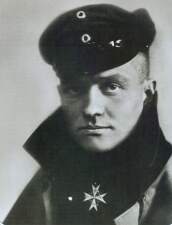

Manfred von Richthofen
The Red Baron - Top Ace of WWI, 80 victories
By Stephen Sherman, Aug. 2001. Updated Aug. 1, 2012.
The Red Baron was one of those heroes whose life seems almost scripted. Discipline, pride, hunting skills, and Teutonic patriotism all combined in this man, bringing him to the pinnacle of fame which long outlasted the man himself. "Curse you, Red Baron," cried Snoopy, the Mitty-esque canine ace of Charles Schultz' Peanuts comic strip. But Richthofen was no caricature, methodically claiming 80 aerial victories, before falling himself, in a Wagnerian finale.
Youth
Born on May 2, 1892 to a Prussian noble family, junker landholders, Manfred von Richthofen, learned to hunt at an early age.
Growing up in Silesia (now part of Poland) young Manfred learned from his father, a Uhlan career officer, and his maternal Schickfuss relatives. In the protected game forests, he and his brothers, Lothar and Bolko, hunted wild boar, elk, birds, and deer, collected and displayed their trophies in their castle. Later, the great ace would bring the same love of the hunt and love of victory to his aerial battles. He entered the Prussian cadet corps (military school) at age eleven, where he was an indifferent student. In 1911, he entered Uhlan Regiment Number 1, which he enjoyed, at least insofar as the opportunities it gave him to ride horses. He first fought on the Russian front, where the highlight of his cavalry exploits seemed to be capturing and locking up a Russian priest in his own bell tower. Transferred to the West, his Uhlan regiment spent several enjoyable, peaceful months in the rear areas. An assignment to the quartermaster corps didn't satisfy Richthofen. "My dear Excellency," he wrote, "I have not gone to war to collect cheese and eggs ..." He asked to serve with a flying unit. In May, 1915, his request was granted.
Flier
Soon, he was back in the East, as a reconnaissance flier and then a bomber. During June, July and August, 1915, he remained with the 69th Flying Squadron which participated in Mackensen's advance from Gorlice to Brest-Litovsk. He had joined it as quite a junior observer and he had no special expertise. As a cavalryman his business had consisted in reconnoitering. So the Aviation Service as an observer was in his line and he enjoyed the long reconnoitering flights which they undertook nearly every day.
Still dissatisfied, he complained again and was removed to Ostend on the Western front, as a back-seat observer in a reconnaissance plane. With pilot Lt. Zeumer, they patrolled over the North Sea, and once spotted a submarine beneath the water, but did not bomb it as they could not determine its nationality.
His first encounter with an English airplane, on September 15, 1915, ended without real damage to either plane; but gunner Richthofen and pilot Zeumer both thought that the other could have handled the combat better.
Transferred to the Champagne front, he flew with pilot Osteroth. With his ring-mounted machine gun, he managed to shoot down a Farman aircraft, but could not get credit for the kill, as it fell behind Allied lines. His hunter's instinct had been awakened.
Still determined to join the great hunt in the skies, he started pilot training in October, 1915, making his first solo on the 10th. He damaged the plane on landing and had to take more training at Doberitz.
On Christmas Day, 1915, he passed his examination. In connection with it, he flew to Schwerin, where the Fokker works are situated. From Schwerin flew to Breslau, to Schweidnitz, to Luben and then returned to Berlin. During his tour, he landed in many places in between, visiting relatives and friends. Being a trained observer, he did not find it difficult to find his way. In March, 1916, he joined KampfGeswchader 2 before Verdun and learned learned how to handle a fighting two-seater airplane.
Assigned a two-seat Albatros BII reconnaissance plane (max speed 66 MPH, 100 HP engine, ceiling 9,840 feet), he rigged a machine gun on the upper wing, much like the Nieuport 11. Piloting this Albatros over Verdun on April 26, 1916, he sighted a French Nieuport and opened up at 60 yards. The stricken French fighter dived into Fort Douamont; Von Richthofen had his first kill, although he would gain no official credit. While in France, he had a few opportunities to fly a Fokker single-seat fighter, further whetting his appetite to fly fighters.
Again switched back to the Russian front, he continued to fly "C" class reconnaissance/light bombers. As the Russians had few planes, flying and bombing there was agreeable duty, relatively safe and with readily accomplished missions, like bombing the Manjewicze railway station, strafing Cossack cavalry, knocking out the Stokhod River bridge, etc..
In August, he met the great ace Oswald Boelcke (40 kills), who was in the East recruiting fliers for a new Jagdstaffel (Jasta 2). After a brief interview, Boelcke took Richthofen back with him, to the Somme.
Boelcke's Pupil
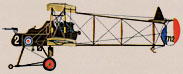
While the well-organized British air arm held command of the air over the bloody battlefield of the Somme, Boelcke's new group, Jasta 2, made an immediate impact. On Sept. 17, 1916, in Jasta 2's first mission, the baron shot down an FE-2 two-seater. (Built by the Royal Aircraft Factory, FE-2's frequently fell to von Richthofen. The FE-2 biplane featured a pusher propeller, mounted aft of the short pod containing the observer, the pilot, and the 160HP Beardmore engine. Used both as a fighter and a reconnaissance plane, both of its crew had a machine gun, giving it a certain strength in redundancy.)
On the morning of the 17th, Boelcke led his squadron up and spotted the English planes first. They were heading toward Cambrai, with Jasta 2 between them and their own lines. Richthofen approached one, maneuvering to get behind it, where he would have the advantage. The English pilot twisted and turned expertly, but briefly let Richthofen behind him. Richtofen described the action:.
In a fraction of a second I was at his back with my excellent machine. I gave a few bursts with my machine gun. I had gone so close that I was afraid I might dash into the Englishman. Suddenly, I nearly yelled with joy for his propeller had stopped turning. I had shot his engine to pieces; the enemy was compelled to land, for it was impossible for him to reach his own lines. The English machine was curiously swinging to and fro. Probably something had happened to the pilot. The observer was no longer visible. His machine gun was apparently deserted. Obviously I had hit the observer and he had fallen from his seat.
The Englishman landed close to one of our squadrons. I was so excited that I landed also and in my eagerness, I nearly smashed up my machine. The English airplane and my own stood close together. I had shot the engine to pieces and both the pilot and observer were severely wounded. The observer died at once and the pilot while being transported to the nearest dressing station. I honored the fallen enemy by placing a stone on his beautiful grave.
For the next month, Jasta 2 "found a happy hunting ground over the Somme battlefield." Ironically, Boelcke did not live long to enjoy the success of his new elite Jasta. He was killed in early November, in a collision with another German flier; von Richthofen carried the great ace's decorations on a pillow in his funeral. By Nov. 9, von Richtofen had increased his score to ten.
Death of Major Hawker, V.C.
Like any great hunter, Manfred von Richthofen reveled in bagging the largest game. On November 23, 1916, he encountered Major Lanoe George Hawker, V.C., "the British Boelcke," in Richthofen's words, big game indeed. Hawker was one of the first fliers to take a pistol with him in the air and was also the first to arm an early Bristol scout with a Lewis gun. He downed a German two-seater over Ypres in July, 1915. Flying constantly, he downed one German plane after another. (In those early days, British records of aerial victories were not kept as carefully as later.) Hawker was decorated with the Victoria Cross and given command of Number 24 squadron.
On the morning of the 23rd, Hawker led three planes in an attack on some German two-seaters. But it was an ambush. The bait promptly fled, while Richthofen's fighters dived after the British fliers. Lieutenants Andrews and Saunders were hit, but managed to escape. Hawker stayed to fight; against him were Richthofen and the best pilots of Jasta 2.
Starting at 6,000 feet, the airplanes tore at each other, twisting and turning in descending circles, down to 2,000 feet. Desperate to gain an advantage, Hawker looped and got off a burst. He missed and fled for home, now at tree-top level. But the German aircraft was faster and Richthofen was determined.
In Richthofen's own words:
Our speed is terrific. [Hawker] starts back for his front. He knows my gun barrel is trained on him. He starts to zigzag, making sudden darts right and left, confusing my aim and making it difficult to train my gun on him. But the moment is coming. I am fifty yards behind him. My machine gun is firing incessantly. We are hardly fifty yards above the ground - just skimming it.
Now I am within thirty yards of him. He must fall. The gun pours out its stream of lead. Then it jams. Then it reopens fire. That jam almost saved his life. One bullet goes home. He is struck through the back of the head. His plane jumps and crashes down. It strikes the ground just as I swoop over. His machine gun rammed itself into the earth, and now it decorates the entrance over my door [to the family castle at Schweidnitz]. He was a brave man, a sportsman, and a fighter.
Hawker was Richthofen's eleventh victim. Another order went to his Berlin silversmith, for a plain, silver cup, just two inches high, engraved briefly with the aircraft and date of his victory.
The Flying Circus
After victory number 16, he was awarded the Pour le Mérite (the Blue Max). He then organized his own Jagdstaffel 11, dubbed by journalists "The Flying Circus." His qualities showed. He was methodical; he figured the odds; with mathematical precision, he calculated position, angles, and fire control to kill his prey. He led his group with order and discipline, requiring his fliers to study and follow his tactics. About this time (late 1916), he painted his aircraft red, and began to be known as "The Red Baron."
But even Richtofen, in his new all-red Albatros D III, didn't always have it his own way. On January 23, 1917, the Richthofen Circus pounced on some British camera planes of the 25th Squadron (FE-2 two-seater, pusher planes). Richthofen fired into an airplane piloted by Capt. Grieg, with 2nd. Lt. J. E. MacLenan as observer. His bullets tore into Grieg's leg, who struggled heroically to regain control of the aircraft. Oil splattered all over the wounded craft. MacLenan tossed the camera over and began firing his Lewis gun. He and the nearly blinded Grieg kept shooting back at the relentless Red Baron, and eventually their bullets crippled the Albatros, cracking its wing. Both aircraft crash-landed near Vimy. As German infantry approached, Grieg fired a flare pistol into his downed plane, setting it afire, thus denying it to the Germans.
In mid-March, he got it again, this time when his group of five planes attacked fifteen British machines over Lens. As the enemies had seen each other at a great distance, both groups flew right at each other for several nerve-tingling minutes. When one of the British scouts peeled off, Richthofen thought he had an easy kill. Closing to fifty meters on the straggler, he test-fired his guns, and calmly planned his enemy's destruction. He suddenly realized that he had been ambushed when his Albatros was hit by machine gun fire. His fuel tank was holed, so he switched off his engine promptly. Even one drop on the hot engine could have fatally ignited his plane. He managed to bring his aircraft down behind German lines, but had difficulty persuading an officer that he had, in fact, shot down twenty-four airplanes.
By March 26, 1917, the Baron had downed thirty-one Allied planes. He had become a cold, ruthless hunter and killer; machine guns helpless pilots of crashed aircraft and blasting his victims as they tried to escape the cockpits of doomed airplanes. He carried with him a gruesome photograph of a British flier he had horribly shot apart, the photograph given to him by an admiring German infantry colonel.
Bloody April
The British airmen were obsessed with the Red Baron and were determined to destroy him, one way or another. On April 5, they planned a massive bombing raid on his aerodrome at Douai. German intelligence alerted Richthofen, but he choose to stay put. A few hours before the raid was due, he and his senior pilots sat down to a splendid dinner. While they puffed their after-dinner cigars, the phone rang, "English bombers on the way." In the dugout bomb shelter, he entertained his men with wine, ribald stories, jokes, and tales of aerial combat. Meanwhile, no British bombers came over. Finally, seventeen of the bombers found the Baron's field and loosed their destruction. The bombs found fuel and ammunition stores, setting huge explosions. The hangars were hit by the second wave. But Manfred von Richthofen and his crack pilots were unhurt.
In the month of April, Jasta 11 shot down 89 British airplanes. As winter weather had cleared, both sides were able to fly a lot. The Germans could employ their group fighting tactics. And their Albatros D.III scouts over-matched the British pusher biplanes and the French Nieuport 11's. Manfred von Richthofen alone claimed 20 in the month.
Wounded, July 1917
The German press, eager for any good news or for any hero from the mindless, muck and blood-filled horror of the stagnant trenches, showered the Red Baron with adulation. After a short leave in May, he hurried back to rejoin The Flying Circus. By the end of June, 1917, his collection of little silver cups totaled fifty-six.
Then, on July 2, he encountered the British RFC 20th Squadron, and two of its pilots: Flt. Cdr. A. E. Woodbridge and Capt. Pilot D. C. Cunnell. Woodbridge described the action:
Cunnell handled the old FE for all she was worth, banking her from one side to the other, ducking dives from above and missing head-on collisions by bare margins of feet. The air was full of whizzing machines, and the noise from the full-out motors and the crackling machine guns was more than deafening ... Cunnell and I fired into four of the Albatroses from as close as thirty yards, and I saw my tracers go right into their bodies. Those four went down ... Some of them were on fire - just balls of smoke and flame - a nasty sight to see.
Two of them came at us head-on, and the first one was Richthofen. There wasn't a thing on that machine that wasn't red, and how he could fly! I opened fire with the front Lewis and so did Cunnell with the side gun. Cunnell held the FE on her course and so did the pilot of the all-red scout [Richthofen]. With our combined speeds, we approached each other at 250 miles per hour ... I kept a steady stream of lead pouring into the nose of that machine.
Then ... The Albatros' pointed her nose down suddenly and passed under us. Cunnell banked and turned. We saw the all-red plane slip into a spin. It turned over and over, round and round, completely out of control. His motor was going full on, so I figured I had at least wounded him. As his head was the only part that wasn't protected by his motor, I thought that's where he was hit.
Indeed, a British bullet had creased and partially splintered his skull. Despite the best treatment available for the national hero, the wound never properly healed; the scar tissue, bone splinters and even thorns continued to cause Richthofen maddeningly painful headaches. He went home on leave, but when he returned, his skills were off. He went two weeks without a kill.
By September, now flying the famous red Fokker Dr.I triplane, he had recovered enough to reach the 60 victory milestone, an unprecedented achievement.
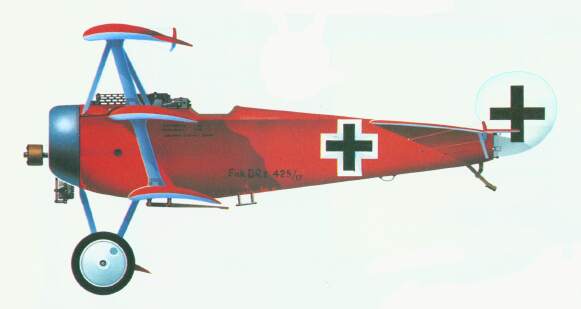
Fokker Dr. 1, built 1917,
powered by
Thulin-built Le Rhône 9J 9-cylinder air-cooled rotary 110 HP engine,
weighed 1,289 lbs., max. speed of 103 MPH, max. ceiling of 19,685 feet,
2 synchronized Spandau machine guns
Winter, 1917-18
After a Christmas leave, hunting in the Bialowicka forest with Lothar, he resumed his pursuit of aerial quarry. When he downed 2nd Lt. H. J. Sparks, his 64th, he sent the hospitalized British flier a box of cigars. In March and April of 1918, he shot down 17 airplanes, while flying his trademark all-red Fokker Triplane.
Richthofen's last victory was number 80; Lt. D. E. Lewis walked away from his wreck.
Last Dogfight
Canadian Capt. Roy Brown led a flight fifteen Sopwith Camels on the morning of April 21, 1918, flying cover for some photo planes. When some Fokkers and Albatroses jumped the camera planes, a huge dogfight ensued, over thirty planes twisting, shooting, and tearing at each other. A scarlet Albatros got behind a young Canadian, Lt. Wilford May. Seeing his plight, Capt. Brown went after the Baron, firing his Lewis gun.
And then the aircraft of the Red Baron, Manfred von Richthofen, dived and crashed near Sailly-le-Sac, an area held by Australian infantry. The Aussies immediately recovered the plane and were astonished to discover inside Richtofen's body. Almost as quickly, the event became the subject of confusion. The low-key Captain Brown never officially claimed the kill; and some Australian gunners did. To this day, no one knows for sure who brought down the greatest ace of The Great War.
Funeral
The British decided to hold a grand funeral for their late adversary. Laid out on a lorry, covered with flowers, escorted by RAF officers, his body was taken to a hangar, where it lay in state for a day. Hundreds of British soldiers filed past to view the Red Baron. The next day, the burial itself was another military pageant, with six RAF Captains as pallbearers, a fourteen-man firing party with rifles reversed, a flower-draped coffin, a service conducted by a robed chaplain, and a bugler blowing "The Last Post."
Photographs were taken of the funeral, and British planes dropped them over his airdrome at Cappy with the message:
TO THE GERMAN FLYING CORPS:
Rittmeister Baron Manfred von Richthofen was killed in aerial combat on April 21st, 1918. He was buried with full military honours.
From the British Royal Air Force
Summary of Victories
Von Richthofen's eighty victories have been as well-researched as any fighter pilot's claim. See this detailed list of The Red Baron's Kills. A surprisingly large percentage of his 80 kills can be matched to specific British loss records.
Most of his victories came in the spring. In March/April of 1917, he downed 31 planes. In the same two months of 1918, he downed 17 aircraft. During most other months of active flying (from Sept. 1916 through April 1918), he usually claimed 3 to 6 kills each month. In the three months Aug., Sept., and Nov. 1917, while recovering from his injury, he only shot down 6 planes altogether.
He brought down sixteen B.E.2's, thirteen F.E.2's, eight Sopwith Camels, seven R.E.8's, five Brisfit's, five Spad VII's, five Nieuports, and fewer numbers of nine other types.
Richthofen Castle
The Red Baron's legacy lives on in popular culture, in the Peanuts cartoon, in a pop song of the 1960s, and even a castle in Denver. Modeled on the original family home in Germany, the Denver castle was built by Manfreds' uncle and godfather, Walter, in 1887. The local rumor that it is haunted, and it was recently up for sale, for only $3,000,000.
Another aspect of his legacy was the board game "Richthofen's War," a strategy game made by Avalon Hill in the 1970s. As far as I know, "Richthofen's War" has not been released as a video/PC video.
Richthofen's Grave
After Richthofen's death in 1918, the British buried his remains in a village churchyard at Bertangles, France, with full military honours. Later the coffin was transferred to a War Graves Commission cemetery. In 1925, it was moved to the Invalidenfriedhof in Berlin (the Prussian national military cemetery), at the request of German veterans' organisations. German President von Hindenburg, the Chancellor, and the whole cabinet were among the dignitaries present. Von Richthofen's reburial was seen as a symbol of homecoming for many who had suffered loss in WWI.
In 1961 when the Berlin Wall was constructed, the Invalidenfriedhof was at the very edge of the demarcation zone in the Russian sector. It was only possible to visit the cemetery with special permission. For this reason von Richthofen's surviving brother, Bolko, got permission from the East German government to rebury the remains in the family burial plot in Wiesbaden. The reburial book place in 1975.
Sources:
- The Red Air Fighter, by Manfred Von Richthofen, Norman Franks; originally written in 1917
- The Aerodrome
- Heroes of the Sunlit Sky, by Arch Whitehouse, Doubleday, 1967
- The Canvas Falcons, by Stephen Longstreet, Barnes & Noble, 1970
- Rand McNally Encyclopedia of Military Aircraft: 1914-1980, by Enzio Angelucci, The Military Press, 1983
 The Red Air Fighter, by Manfred Von Richthofen,
Norman Franks
The Red Air Fighter, by Manfred Von Richthofen,
Norman Franks
Manfred von Richthofen's 1917 book. The German title Der Rote Kampfflieger has also been variously translated as "Red Fighter Pilot" and "Red Battle Pilot." This edition includes C.C. Grey's preface to the original, wartime English translation. It's written in the first person, in a very immediate style, of course from von Richthofen's own perspective. It stops in mid-1917, just before his bad injury. It also includes a chapter on Manfred's brother, Lothar. |
 |